Payroll Software Security and Data Privacy Standards to Require
Payroll systems need encryption, multifactor authentication.
Payroll software holds the single richest identity file a company keeps on an employee: full legal name, Social Security number, bank routing number, salary history, tax withholding elections, benefits selections, and, on newer platforms, biometric login data. That concentration is why the software running it can't be chosen on price or interface alone. In 2025, breaches of HR and payroll systems leaked an estimated 12.6 million employee records worldwide, and the pattern behind those numbers says something specific about where the risk sits and how long it goes unnoticed.
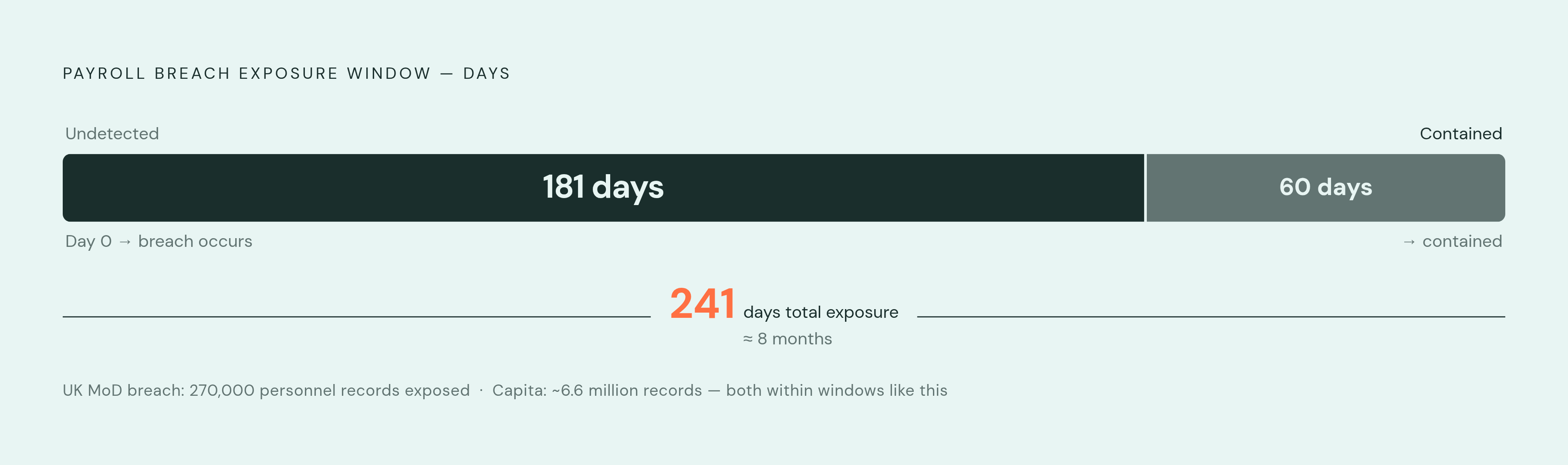
Scale tells part of the story. The UK Ministry of Defence breach exposed personal data belonging to 270,000 current and former personnel. Capita's 2023 breach pulled data on around 6.6 million people, and a UK data protection regulator fined Capita plc and Capita Pension Solutions Limited a combined £14 million for failing to put adequate security measures in place under UK GDPR. Insider cases show the same exposure from a different angle: a former payroll manager stole $2.5 million through fabricated expense reimbursements, and a former payroll employee at Goya Foods took $274,000 before anyone caught it. What connects all of these isn't the method, it's the delay. The average breach takes 181 days to even get noticed, and another 60 days to contain. That leaves nearly nine months where money or data can move before anyone acts on it.
The evolving threat landscape: AI-driven attacks, insider risk, and supply chain exposure
Roughly 70% of incidents still start with something ordinary, such as a phishing email, a weak password, a report sent to the wrong inbox, or a login shared between two people who shouldn't both have it. The mechanics haven't changed much. What's changed is how convincing the bait has gotten.
Business email compromise has moved into what's being called BEC 2.0, where attackers study a company's actual internal email traffic first, tone, timing, phrasing, and then mimic an executive's writing style closely enough to fool someone who'd normally catch a fake. Layered on top of that is a newer trick: deepfake "vishing," where an AI-cloned voice calls a payroll or HR staffer, claims some kind of emergency, and asks for an urgent change to a direct deposit account. It's flagged as one of the more alarming trends heading into 2026, and for good reason, since it defeats the one instinct people rely on most, recognizing a voice. Analysts project AI-powered phishing will account for 42% of global intrusions by late 2026.
That doesn't displace the insider threat, it just adds to it. Malicious insider attacks carry the highest average cost of any initial attack vector, $4.92 million per incident, for the second year running. And the door doesn't have to be the employer's own network. A lot of exposure now comes through a third-party payroll processor, a time-tracking app, or an HCM platform that has bridge access into the employer's systems, so the weak point can sit two or three vendors removed from the company that actually gets hurt.
Encryption standards that should be non-negotiable
Encryption isn't a single checkbox, it's two separate requirements that need two separate answers. Data sitting in storage needs AES-256, the encryption standard used by the leading payroll platforms to protect stored records. Data moving, between the employee's portal, the payroll engine, and the receiving bank, needs TLS 1.3 with Perfect Forward Secrecy, and TLS 1.3 or higher is now the accepted floor, not the ceiling.
Even if an attacker later gets hold of a session key, they can't reach backward and decrypt sessions that already happened, and that is why Perfect Forward Secrecy earns its place on this list. Even if an attacker later gets hold of a session key, they can't reach backward and decrypt sessions that already happened. Given that breaches sit undetected for an average of 181 days, one exposed session without that backward protection becomes every session exposed retroactively.
Buyers should ask vendors directly which standard governs data at rest versus data in transit, and get the answer in writing rather than in a sales deck. Ask, too, whether encryption holds consistently across multi-cloud environments, since that's a dimension covered in the SOC 2 discussion further down. And one gap gets missed constantly: a vendor's encryption stops mattering the moment someone exports a payroll report to a desktop or drops it on a shared drive. At that point, the vendor's controls no longer apply, and the exposure belongs entirely to the employer.
Authentication and access controls: limiting who can reach what
A password alone isn't enough to protect financial data of this kind in 2026, full stop. Multi-factor authentication is the baseline now. The stronger implementations use hardware keys or biometric authenticator apps rather than SMS codes, which remain vulnerable to SIM swapping. For small businesses without a dedicated IT staff, MFA is arguably the single highest-return security step available, cheap to turn on and disproportionately effective against the most common attack paths.
Access needs to be layered the same way. Role-based access control, built around the Principle of Least Privilege, means a junior HR assistant might legitimately need to see an employee's name but has no business seeing that employee's bank account number or salary. Access isn't a switch that's either on or off; it's a set of doors, and each person should only hold the keys their job actually requires. That access also needs to disappear the moment a role changes or someone leaves, immediately, not at the next quarterly access review, which is often where the real gap sits.
The structural idea driving all of this is Zero Trust: no user or system is trusted automatically, regardless of whether the request comes from inside the network or outside it. Given the supply chain exposure and remote access risk already described, that assumption isn't optional anymore, it's the model the rest of the controls sit on. Before signing anything, ask whether MFA is enforced at the platform level rather than just recommended, confirm that RBAC can be configured down to the granularity the org chart actually requires, and find out how access gets pulled when someone's role changes.
Audit logs, monitoring, and incident response capabilities
Every access event and every change needs to leave a trace that can't be edited after the fact. That's what an immutable audit log gives an organization, and it's the backbone of any forensic investigation or regulatory defense that comes later. Without it, there's no way to reconstruct what happened, only guesses.
Automated anomaly detection is what turns that log into something proactive rather than just a record. A sudden salary increase, a new direct deposit account added days before a pay run, duplicate payment entries, these are exactly the signatures that BEC and insider fraud leave behind, and catching them in real time is what stops a $274,000 theft from turning into something larger.
Retention matters on both ends of the timeline. How long payroll data gets kept is often dictated by law, and how it's disposed of once that period ends matters just as much as how it was protected while active. And before signing with any vendor, get three things in writing: a documented incident response plan (not a verbal assurance that one exists), guaranteed uptime SLAs, and a clear breach notification timeline, since that last one ties directly into the regulatory deadlines covered below.
What SOC 2 Type II certification tests, and why it tests over time
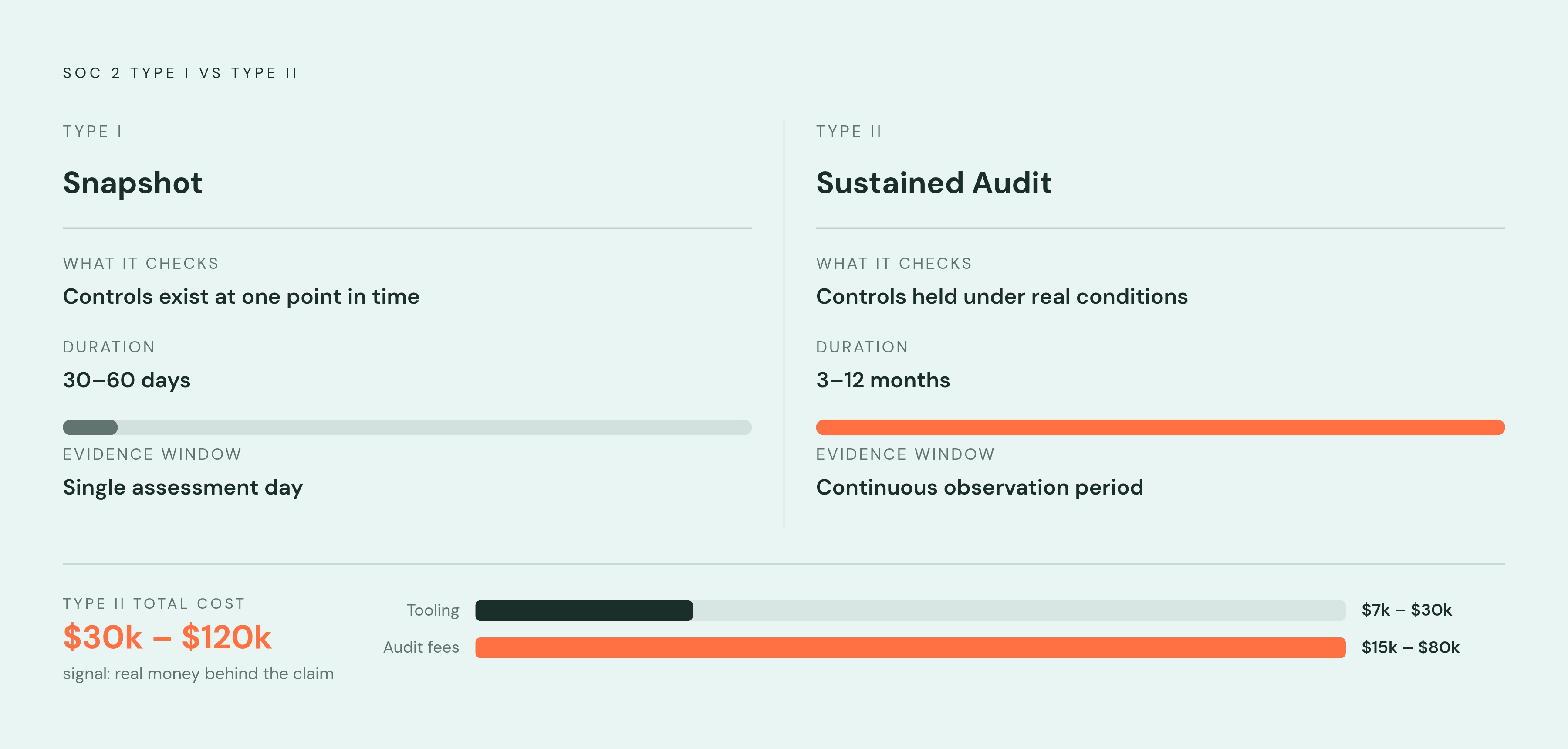
SOC 2 comes in two forms: one is a promise, the other is a track record. Type I checks whether a vendor's controls are designed correctly at one point in time, typically completed within 30 to 60 days. Type II checks whether those same controls actually held up under real operating conditions over a much longer stretch, three to twelve months. Most enterprise buyers require Type II specifically, because a Type I report only proves the controls looked good on paper the day someone checked.
SOC 2 certification is technically voluntary. In practice, it functions as a gate: plenty of enterprise and healthcare clients won't even evaluate a vendor that doesn't hold it. What a 2026-era SOC 2 audit actually examines has expanded too. Auditors now look for continuous risk assessment rather than a single snapshot, closer scrutiny of a vendor's own third-party relationships, Zero Trust access controls, data classification and encryption across multi-cloud setups, and generally more detailed reporting than what satisfied auditors a few years back.
For buyers sizing up a vendor that isn't certified yet, cost is a useful signal in itself. Compliance tooling licenses run $7,000 to $30,000. Audit fees from a qualified assessor run $15,000 to $80,000. All in, a first SOC 2 Type II typically costs a vendor $30,000 to $120,000. That's not trivia; it's a rough proxy for whether a vendor has actually put money behind its security claims or is hoping no one asks.
ISO 27001 and the IRS Safeguards Program as complementary frameworks
ISO 27001, not just SOC 2, is a credential worth checking, and it may matter most. ISO 27001 is an international standard for information security management, and it complements SOC 2 rather than duplicating it. ADP, for one example, holds SOC 1, SOC 2, ISO 9001, and ISO 27001 together, which gives a sense of what a fully credentialed vendor's paperwork actually looks like.
The two frameworks cover different ground. SOC 2 is U.S.-centric and built around trust-service criteria. ISO 27001 is recognized internationally and covers the broader information security management system end to end, which matters a great deal for any buyer running payroll across borders or managing a global workforce.
Two more frameworks deserve a place on the checklist. The IRS Safeguards Program is a framework buyers should ask vendors about when federal tax data is involved, and confirming current compliance rather than assuming it carries over is the safer approach. And when a platform bundles payroll with health benefits data, which is common in integrated HCM systems, buyers should confirm what additional regulatory obligations apply to that layer. It's a dimension that gets overlooked constantly by buyers evaluating a vendor's payroll-only certifications and forgetting the benefits module sits right next to it.
The US state privacy law patchwork governing payroll data
No federal privacy law governs payroll data uniformly, which leaves buyers navigating a state-by-state patchwork, and California's is the one that carries the most weight. The CPRA extended full CCPA privacy rights to employees, job applicants, and contractors, closing exemptions that existed under the original CCPA. Coverage applies to for-profit businesses with annual gross revenue over $26,625,000, or those buying, selling, or sharing personal data on 100,000 or more California residents a year, or those drawing half or more of their revenue from selling or sharing personal information. Under the CPRA, covered employers have to provide a privacy notice at the point data is collected and respond to employee data requests within 45 days.
That bar is likely to rise further. On April 20, 2026, the California Privacy Protection Agency opened preliminary rulemaking focused specifically on employee data and privacy notice requirements. The outcome isn't settled yet, but the direction is clear enough: California's employee data rules are headed toward stricter, not looser. Separately, CPRA's automated decision-making provisions taking effect in 2026 are relevant to any payroll vendor that builds or integrates AI-driven HR tools.
Other states are cutting their own path. Maryland's MODPA pairs a low coverage threshold with strict data-minimization requirements and an outright ban on selling sensitive data, a combination stricter than most comparable state laws and one that payroll vendors serving Maryland employees can't treat as an afterthought.
The 2026 OBBBA payroll reporting changes for software
A recent federal law brings a set of payroll reporting changes in 2026 that go well beyond a routine form update, expanding both the level of detail required on wage reporting and the categories that data has to be split into. New W-2 reporting codes are designed to capture specific compensation categories with more precision than the old wages-and-tips buckets allowed. Specific compensation categories now need to be tracked and reported separately rather than folded into general earnings.
That's a real configuration problem. Employers can no longer lump earnings into broad categories and call it close enough, every compensation type has to be mapped, calculated, and reported under its own specific classification. Which makes this the sharpest test of a payroll vendor's actual engineering, not their sales pitch: has the platform already been rebuilt to handle these classifications correctly, or is it still running on the old categories and hoping nobody notices before the first reporting deadline hits?