In-House Payroll Software vs Payroll Service Bureau
The choice hinges on hidden costs that most companies never fully calculate.
The name is this: this is a framework, not a recommendation, but the framework has a bias, and it favors the honest math over the comfortable default. Companies that never redo that math end up defending a choice they made three years ago for reasons that no longer apply.
Research consistently shows that a large majority of workers would face financial difficulty if their paycheck were delayed by even one week, and that fact alone settles the argument that payroll accuracy is an administrative nicety. Payroll accuracy is not an administrative nicety. The market reflects how unsettled the underlying question still is: both payroll software and payroll outsourcing are multibillion-dollar industries, growing year after year, with neither model close to overtaking the other. What follows breaks the decision down across four dimensions, size and complexity, compliance exposure, internal capacity, and appetite for control, and argues for a specific reading of each.
What each model is, and what it is not
In-house payroll software is a platform the company's own staff runs. The vendor supplies the technology and the tax tables. The internal team supplies the labor and carries the compliance responsibility on its own shoulders. A service bureau, sometimes called managed payroll, flips that arrangement: the provider runs the payroll cycle end to end, gross-to-net calculations, tax filings, statutory reporting, year-end forms, while the employer just approves inputs and outputs instead of processing them.
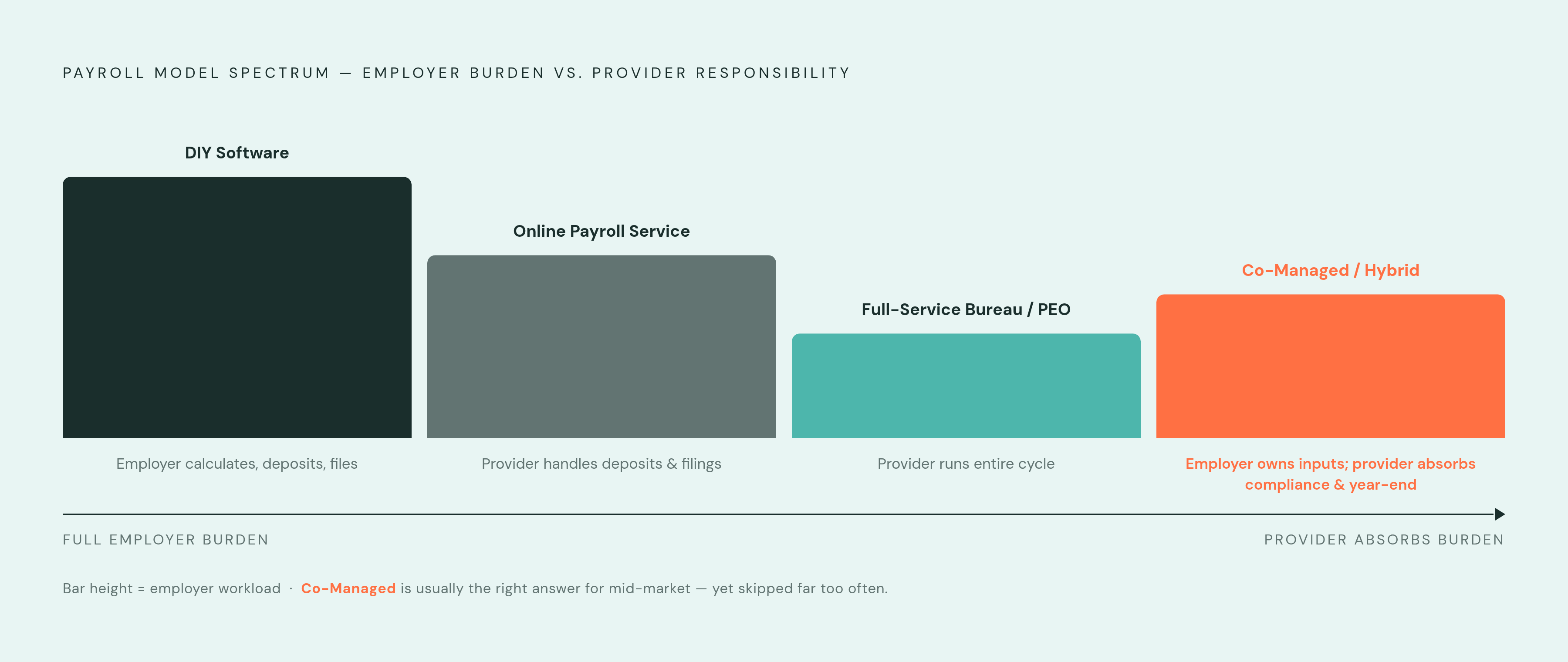
This is a spectrum, not a coin flip, and treating it as binary is the first mistake most companies make. At one end sits DIY software, which calculates wages and withholding but leaves the employer to make tax deposits and file returns. In the middle sits online payroll service, combining hands-on management with tax deposits and filings bundled in. At the far end sits the full-service bureau or PEO, running the entire cycle with minimal employer input.
A fourth option gets skipped far too often: the hybrid, or co-managed, model. The company keeps the platform and controls the inputs, while the provider absorbs the high-risk layers, tax filings, statutory compliance, year-end forms, multi-jurisdiction reporting. For mid-market companies caught between the two extremes, this is usually the right answer, not a compromise settled for.
Outsourcing does not transfer statutory obligations to the provider, so legal liability to tax authorities and to employees stays with the employer. Legal liability to tax authorities and to employees stays with the employer, full stop. A managed contract makes the provider financially accountable to the company for errors within its scope, through service-level agreements and indemnities, but that's a different thing from statutory liability. The word "outsourcing" tempts people into believing they've handed off accountability. They've handed off processing.
The true cost of each model, once people are included
Sticker prices lie in both directions. Software looks cheap right up until someone adds the salaries of the people who run it. Managed payroll looks expensive right up until those same salaries get subtracted from the other side of the ledger. Most companies never make that subtraction. The comparison stays broken as a result.
The honest in-house cost equation is subscription or license fees plus fully loaded payroll staff salaries and benefits. For any company of meaningful size, that staffing line alone is a substantial fixed cost before a single software invoice even arrives.
Service bureau pricing follows a familiar shape: a base fee, often $50 to $80 per month according to Sage HCM's published pricing, plus a per-paycheck charge, typically $2 to $5 per paycheck per QuickBooks/Intuit's pricing. Workforce.com's 2025 reporting puts Gusto's Simple plan at $49 a month plus $6 per month per user, and its Premium tier at $180 a month plus per-user fees. Those numbers look manageable on a slide. They rarely stay that clean once add-ons raise the total cost.
Hidden costs cut both ways. On the outsourcing side: setup fees, per-run charges that double up when a company runs payroll bi-weekly instead of monthly, and add-on modules for HR support or compliance resources. The advertised base rate is rarely the number that shows up on the invoice. On the in-house side: IT support, software updates, compliance updates, staff training, and the cost of fixing mistakes. EY's payroll error research found that one in five payrolls in a certain country contained an error, and each correction costs real time and real money. Under a software-only model, the employer swallows that cost directly, with no SLA to fall back on.
Compliance work itself eats time that has a price tag attached. In Canada, payroll professionals spend 56% of their working hours on compliance tasks, amounting to roughly $9.9 billion a year in labor costs alone. That number says plenty about how compliance-heavy this function is, regardless of which model a company runs. The tail risk runs in one direction only: some U.S. companies have faced penalties as high as $2.4 million for failing to comply with overtime laws. Avoiding that outcome costs far less than absorbing it, and yet plenty of companies budget as if the penalty simply won't happen to them.
The real comparison is software fees plus staff plus error remediation plus penalty exposure, weighed against bureau fees plus transition cost plus the value of SLA protection. Most companies never run that full math, and the ones that skip it are usually the ones defending in-house software for reasons that have nothing to do with cost.
How business size and payroll complexity shift the calculus
Small businesses with simple, single-jurisdiction payroll and a stable headcount are usually well served by in-house software. The compliance surface stays contained, and the learning curve has an end point. The National Small Business Association's 2024 survey found that a significant share of small business owners spend multiple hours a month handling payroll taxes themselves, time that carries real opportunity cost for an owner who could be doing something else with those hours.
Complexity doesn't grow in a straight line as headcount rises. It compounds. More pay types, more benefit structures, more state tax registrations, more year-end forms, and the internal team needed to keep pace has to scale right alongside all of it, which almost never happens smoothly.
Multi-state and multi-country payroll is the clearest tipping point toward a managed model, and companies that ignore this tipping point tend to find out the hard way. Each new jurisdiction brings its own deposit schedule, its own rates, its own reporting forms. Software can technically handle this, but it usually needs added modules and real configuration expertise, and stretched internal teams tend to lack exactly that.
The market itself is telling this story through consolidation. Paychex's acquisition of Paycor in April 2025, a $4.1 billion deal, created a combined portfolio serving a combined customer base in the hundreds of thousands. That kind of scale doesn't happen without genuine enterprise demand pulling companies toward managed models as they grow past the size where a spreadsheet-adjacent system still works.
Fast-scaling companies face a particular mismatch: internal team capacity is fixed, but payroll volume during a hiring surge or a seasonal spike is anything but. Managed providers absorb that variability elastically in a way a fixed internal headcount simply cannot match. As a rough sizing rule, a company with stable, single-country payroll and existing HR or finance expertise is a reasonable software candidate. A company crossing state lines, hiring internationally, or growing faster than its back office can keep pace with is a bureau candidate, and pretending otherwise just delays an expensive correction.
Compliance exposure as a standalone dimension
Compliance doesn't sit still. Tax laws shift, deposit schedules change, W-2 coding rules get rewritten, and wage-and-hour regulations move right along with them. The 2026 IRS updates tied to the One Big Beautiful Bill Act introduced new W-2 Box 12 codes, new Box 12 codes including Code TT and Code TP, and a single manual entry mistake on either code can trigger per-form penalties.
Under the in-house model, the full weight of staying current sits with the employer. The software vendor supplies updated tax tables, sure, but someone internally has to confirm the configuration is right, the filings go out on time, and new rules actually get implemented rather than just installed and forgotten. That takes active, skilled attention.
State-level penalty exposure varies sharply, and treating it as uniform leaves companies caught off guard. A single missed filing in a high-enforcement state can carry a serious penalty, while the same miss elsewhere might draw nothing more than a warning letter.
Managed payroll providers, by contrast, typically carry accuracy commitments through SLAs and, in many cases, indemnification for errors within their contracted scope. That's a form of compliance insurance that in-house software cannot replicate on its own, full stop. A bureau's entire business depends on staying current with the rules. An internal team's compliance knowledge is usually a byproduct of other responsibilities, picked up between other tasks rather than maintained as anyone's main job.
Companies in regulated industries, companies operating in states with frequent legislative change, and companies with complex worker classifications, contractors, multi-state employees, tipped workers, carry the highest compliance exposure of all, and the weight given to this dimension should scale with that exposure rather than sit fixed regardless of industry. Deloitte's payroll operations research found that a substantial majority of organizations outsource at least one payroll activity, and compliance management is often among the first functions to move outside the organization.
Internal capacity: the dimension most decision-makers underestimate
Running payroll in-house takes people who understand both the payroll process and the software itself, and that's a real skill set, not something a generalist office administrator can absorb on the side without risk.
Single-person dependency is a structural weak point in plenty of small and mid-sized companies, where one or two people run the entire payroll process from start to finish. When those people leave, the organization faces disruption that goes well beyond processing delays, hitting compliance and data security too.
Coverage planning gets overlooked more than it should. Payroll runs on a fixed calendar no matter who's available that week. Illness, turnover, a vacation, any of these opens a gap that in-house teams have to plan around ahead of time, and most don't. Managed providers absorb that continuity risk contractually, which is easy to underrate until the one person who knows the system is suddenly unreachable and payday is Friday.
Industry benchmarking indicates that outsourcing meaningfully cuts the payroll FTE ratio compared to fully in-house operations. That's a real efficiency gain, and it cuts the other way too: in-house teams that stick with the fully manual model carry a heavier load per person, and that load compounds. Research indicates that organizations running internal payroll, time and attendance, workforce administration, and benefits functions all in-house spend materially more than organizations that outsource those same functions. The overhead doesn't stay contained to payroll. It spreads across every adjacent function it touches.
A few diagnostic questions cut through the guesswork here. Is there at least one person whose primary job is payroll? Is there a documented plan for what happens if that person leaves or gets sick? Does the team have current knowledge of every jurisdiction where employees get paid? Is the software's compliance configuration actively maintained, or was it set up once years ago and left alone since? A "no" on most of these questions is an honest signal that internal capacity isn't sufficient for safe in-house operation at the company's current complexity, no matter how good the software itself is.
Control and data ownership: what each model gives and takes away
The company decides who touches payroll data, how it's stored, when processing runs, and how errors get resolved, all without waiting on a vendor's schedule or system uptime. Reports, salary history, deduction detail: all available on demand, not stuck behind a provider's export cycle. Customization is in-house's strongest card by far. Policies, benefit structures, leave rules, pay types, all of it can be built around the business's exact needs instead of squeezed into a bureau's standard template.
But control comes with a bill attached. In-house teams carry the full weight of data security, backup, breach prevention, and recovery, and without enterprise-grade security infrastructure behind them, that's a real vulnerability, not a hypothetical one they can wave off.
Bureaus carry a different kind of risk. Every managed payroll provider is a concentrated target: Social Security numbers, bank details, salary data for many clients sitting in one place. A breach there doesn't hit one company, it hits everyone the provider serves at once. Choosing a bureau means relying on that provider's security posture instead of building one internally, which is a trade worth making consciously rather than by default.
Data ownership, portability, access on exit, and what happens during a provider outage should get negotiated explicitly in the contract, since these terms directly decide who controls the data and what recourse the company has when something breaks. "It's governed by the contract" is only as reassuring as the contract actually is, and plenty of contracts are vague exactly where it matters most.
None of this has to be binary. Co-managed arrangements let a company keep platform access and data visibility while handing off the high-risk compliance and filing layers to a specialist. For companies that want oversight without carrying the full processing burden themselves, this is the combination to raise before defaulting to one extreme or the other.
The six-question decision framework
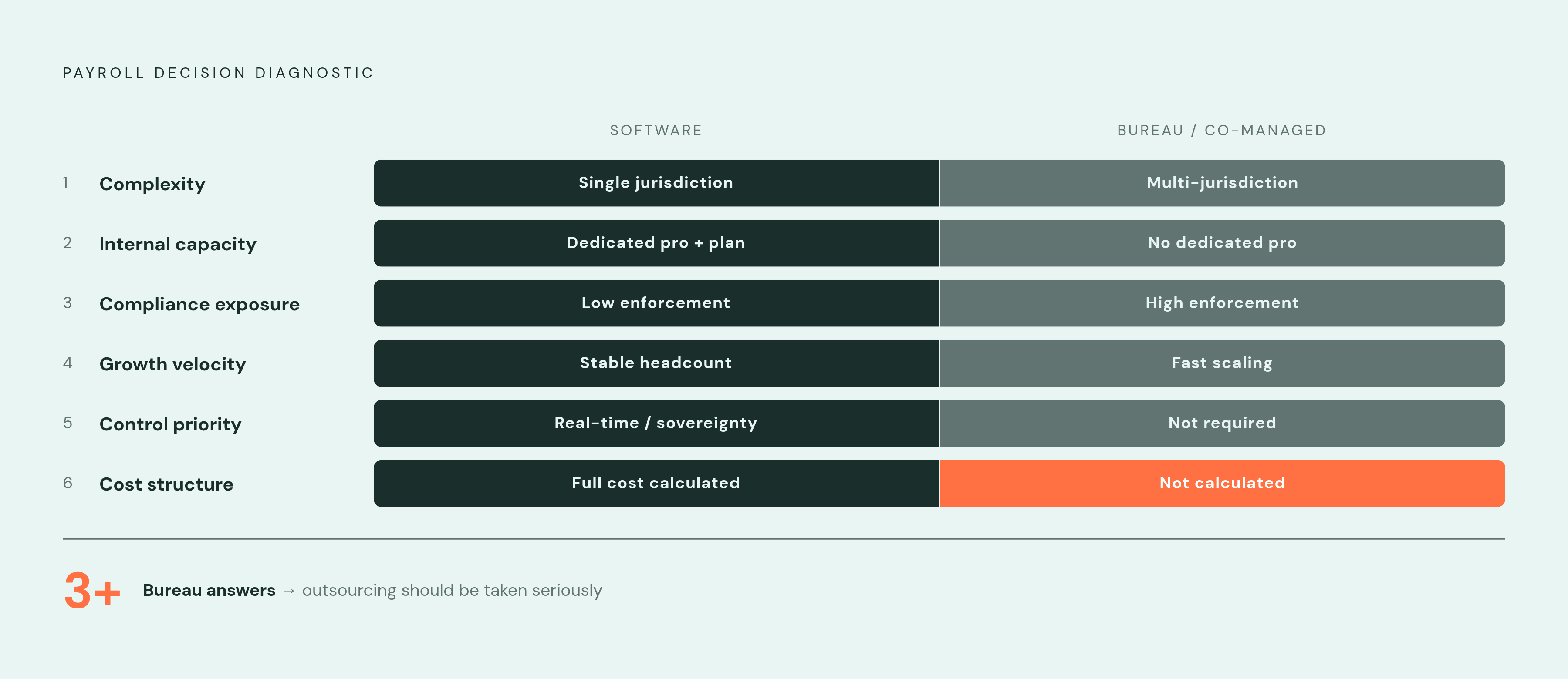
Six questions, taken together, predict which model fits a given company far more reliably than gut instinct or whatever the last vendor pitched.
First, complexity: is payroll single-jurisdiction and stable, or does it span multiple states or countries with different deposit and filing rules? Stable and single-jurisdiction points toward software. Multi-jurisdiction or growing points toward a bureau or co-managed setup.
Second, internal capacity: is there at least one dedicated payroll professional with current compliance knowledge, backed by a continuity plan? If yes, software is viable. If no, managed payroll fills that gap structurally instead of leaving it to hope.
Third, compliance exposure: does the business operate in a high-enforcement state, a regulated industry, or a jurisdiction with frequent legislative change? High exposure tips the value of a bureau's SLA and indemnification well above its sticker price.
Fourth, growth velocity: is headcount stable, or is the company scaling fast enough that internal payroll capacity will lag behind hiring? Fast growth favors a bureau's elastic capacity. Stable headcount means software can keep up fine on its own.
Fifth, control priority: is real-time data access, deep customization, or data sovereignty a genuine operational requirement, not just a preference? High priority favors in-house, or a co-managed setup with strong contractual data access rights built in.
Sixth, cost structure: has the full in-house cost actually been calculated, software plus fully loaded staff plus error remediation, not just the subscription line? If the answer is no, the comparison is incomplete, and any perceived savings might be an illusion sitting on an unfinished spreadsheet.
Companies landing on the managed-bureau answer for three or more of these questions should take outsourcing seriously instead of dismissing it out of habit. Companies landing on in-house consistently across all six can run payroll software with real confidence.
Representative software options for companies that will manage payroll in-house
People Managing People's 2026 ranking of AI payroll software names Paycom, QuickBooks Workforce, and other platforms for companies committed to running payroll themselves. Paycom gets recognized for everyday AI assistance built into HR and payroll workflows. QuickBooks Workforce stands out for mobile paystub access, letting employees check pay details without going through HR. Deel Payroll is recognized for AI-driven handling of multi-jurisdiction complexity, relevant for companies with employees spread across different countries or states.
Each of these serves a different point on the complexity spectrum described above, and the right pick depends far less on brand reputation than on where a company actually lands against the six questions just laid out.