Best Payroll Software for Midsize Businesses With 50 to 500 Employees
Compliance missteps cost midsize companies thousands per incident.
Fifty to 500 employees is the awkward middle seat of the payroll software market. Small-business tools cap out fast; enterprise platforms carry more cost and setup than a lean HR team can justify. This piece walks through what actually changes structurally once headcount crosses roughly 50, what compliance failures cost at this scale, and which platforms handle that tradeoff best.
Something shifts mechanically once a company crosses roughly 50 employees, and it is not just "more people." Pay types start multiplying: hourly, salaried, commission, and hybrid arrangements often show up in the same payroll run instead of neat, separate batches. Multi-state footprints show up too, especially once hybrid work lets someone in Ohio report to a manager in California. Finance, HR, and benefits, which got away with living in separate spreadsheets at 20 employees, now need to actually talk to each other. And the manual workarounds that worked fine at a smaller headcount, the copy-paste fix for a missed deduction, the "we'll true it up next cycle" approach, turn into audit exposure at 150 employees.
What hasn't caught up yet is everything else. Most companies in this band don't have a dedicated payroll operations team. They don't have an IT department sized to manage complicated system integrations. And they certainly don't have enterprise licensing budgets. So the buyer at this scale needs enterprise-grade compliance and integration depth, but wants to pay and implement at small-business speed. Only a handful of platforms actually split that difference well, and the rest of this piece is about which ones do it, and where each one's tradeoffs sit.
What payroll errors and compliance failures actually cost at this scale
Start with the number that should get anyone's attention: businesses paid $2.8 billion in payroll penalties in 2024 for payments that were incorrect or missed entirely. That is not a rounding error in a compliance budget line. That is a structural cost of running payroll wrong, at scale, across the country.
Midsize businesses take more than their share of this. Over 74% of mid-sized U.S. businesses reported at least one payroll-related compliance notice in 2024, a figure that says something uncomfortable about how thinly compliance gets staffed once a company outgrows its founder doing payroll by hand but hasn't yet hired someone whose entire job is getting it right. Multi-state errors rose 38% year-over-year, tied directly to hybrid work, and that trend lands hardest on the 50-500 group precisely because this is the segment doing the most distributed hiring right now.
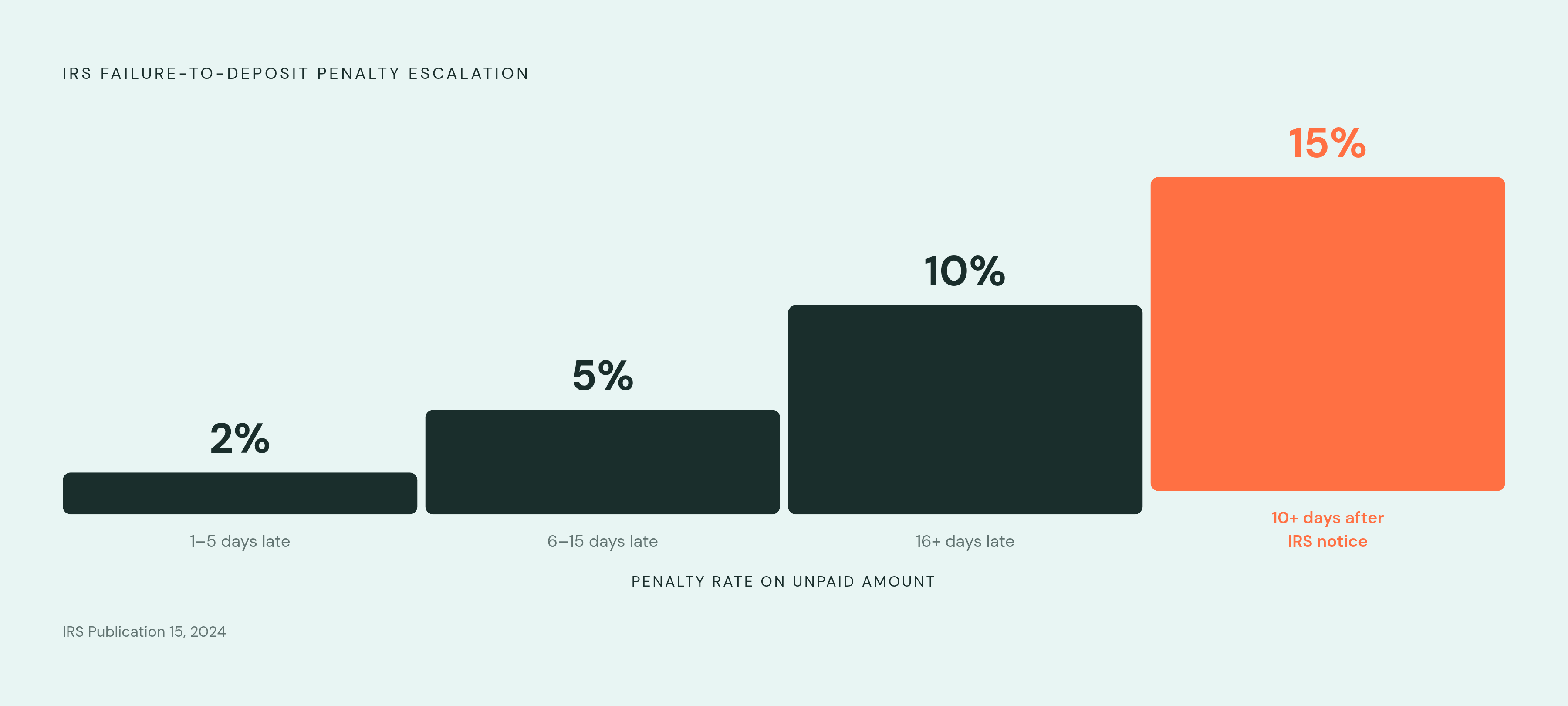
The per-incident math is where it gets concrete. The average fine for a late or incorrect payroll tax filing runs $1,100 per employee, per incident, which means a mistake affecting even a small slice of a 200-person company adds up fast. The IRS doesn't wait around either: failure-to-deposit penalties escalate from 2% for payments one to five days late, up to 5% for six to fifteen days, 10% for anything beyond sixteen days, and 15% if the amount is still unpaid ten or more days after an IRS notice, per IRS Publication 15 for 2024. A 2022 Ernst & Young survey found that one in five U.S. payrolls contains an error, averaging $291 per mistake and running as high as $705 in worse cases.
Then there's the cost that never shows up on a fine notice. Companies spend an average of 120 hours a year just cleaning up payroll problems after the fact, split roughly between 29 hours of litigation and 91 hours of compliance triage. And one in three employees has quit a job over payroll problems, which reframes the whole conversation. Payroll accuracy isn't a back-office finance concern; it's a retention lever, and a broken one costs more than the penalty attached to it.
Here's the uncomfortable arithmetic for anyone shopping on price alone: a platform that saves a few dollars per employee per month but misses one multi-state filing deadline can erase months of those savings in a single incident. Cheap and compliant are not the same axis.
The feature set that actually matters for 50–500 employees
Forget vendor comparisons for a second. What should actually be on the checklist, regardless of brand?
Multi-state tax filing has to be actively maintained, not just technically supported somewhere in the software. Regulations shift constantly, and a platform that requires manual updates every time a state changes its withholding table is a platform quietly asking someone on the HR team to become a part-time tax attorney. Variable pay handling matters just as much: hourly, salaried, commission, and hybrid structures need to run through the same payroll cycle without a workaround. Add in department- and cost-center-based processing for finance reporting, and configurable pay frequencies across employee classes, since a company running weekly pay for hourly staff and semi-monthly for salaried staff shouldn't need two separate systems to do it.
Integration depth beats feature count almost every time. Over 54% of U.S.-based companies already run integrated HR and payroll platforms, so a disconnected payroll system, one that lives apart from HRIS, benefits administration, time tracking, and the accounting or ERP stack, is increasingly the exception, not the norm. Worth asking directly in any sales call: are these integrations truly bidirectional, or is the vendor just exporting a CSV file and calling it an integration?
Employee self-service sounds like a minor convenience until it isn't. Mobile access, pay stub history, W-2 access, and direct deposit management cut the volume of "why is my paycheck wrong" tickets landing on HR's desk, and that reduction is itself a retention lever given the number above about employees who've quit over payroll issues.
Compliance infrastructure needs to include automated W-2 and 1099 generation and filing, and worker classification support has become sharper-edged than it used to be. Worker classification standards have tightened in recent years, and that puts companies with a loose patchwork of contractors and employees at real risk if the platform doesn't help flag misclassification before it becomes a Department of Labor problem.
Scalability is worth interrogating out loud with any vendor: can this platform absorb an acquisition, a new state expansion, or a sudden contractor surge without a full re-implementation? And AI features are worth a skeptical look now that 29% of new implementations involve some AI-powered payroll module. Anomaly detection, predictive compliance alerts, and automated reconciliation are real capabilities worth paying for. "AI-powered" as a marketing phrase slapped on a feature that already existed is not.
What can most midsize buyers skip? Global payroll infrastructure covering 100-plus countries, unless the company is actually hiring internationally. Heavily customized ERP modules built for organizations five times this size. Anything designed to solve a several-thousand-person company's problem, because at 50 to 500 employees, that's cost without value.
ADP Workforce Now: enterprise compliance depth at a premium price
ADP's scale is worth sitting with for a second: the company processes payroll for roughly one in six American private-sector employees, serves more than a million employers globally, and posted north of $19 billion in revenue in fiscal 2025. This is not a scrappy mid-market challenger. It's the incumbent.
That scale shows up in the product. ADP Workforce Now handles multi-jurisdiction compliance across 140 countries and manages domestic multi-state complexity with an infrastructure built specifically for that kind of regulatory sprawl. Its automation engine combines machine learning, predictive analytics, and compliance monitoring in a way that's among the more mature implementations in this category, running multi-layer validation on payroll calculations and flagging compliance issues across jurisdictions before they become fines.
The honest tradeoff is price. ADP's cost structure makes it overkill for a large share of mid-market companies, and buyers on the smaller end of this range, 50 to 200 employees, should pressure-test hard whether they're paying today for compliance capability they won't actually need for another three or four years of growth. The platform makes the most sense for companies at the upper end of the 50-500 band, 300 to 500 employees, operating across multiple states or countries, where the compliance complexity genuinely justifies the price tag.
One question worth asking directly before signing: what's actually included in the base quote versus what shows up later as an add-on module? ADP's pricing structure is modular enough that a number that looked reasonable at the pitch meeting can climb well past it by implementation.
Paychex Flex (with Paycor): competitive mid-market pricing after a market-shifting acquisition
Paychex closed a $4.1 billion acquisition of Paycor in April 2025, and it's one of the more consequential consolidation moves the mid-market HRIS space has seen recently. Two companies that used to compete for the same 50-500 employee buyer are now one company, and that changes the calculus for anyone shopping this segment.
Each brand brought something different to the table. Paychex brought competitive mid-market pricing, status as the largest 401(k) provider in the country, and a wide bench of HR service offerings built over decades. Paycor brought sharper, more modern technology aimed squarely at the 50-500 tier, including a machine-learning-driven onboarding and payroll sync tool aimed at reducing manual employee data entry. Combined, the pitch is a more technically capable platform priced below what ADP charges most midsize buyers.
Paychex Flex itself offers solid tax management, employee self-service portals, and a broad range of HR services, functioning as a strong generalist platform, though without the kind of narrow technical specialization Rippling brings to areas like IT provisioning. It fits well for businesses in the 50 to 200 employee range that want a customizable, full-service payroll and HR setup without paying ADP's premium.
One caution during this integration window: ask specifically which Paycor features have been fully folded into the combined platform and which are still running on separate infrastructure. Post-acquisition roadmaps take time to settle, and buyers signing now should know exactly what they're getting versus what's still being stitched together.
Paylocity: the user experience case for midsize HR teams without dedicated payroll staff
Paylocity positions itself as a cloud-based HCM built specifically for small to midsize businesses, folding payroll, HR, workforce management, tax compliance, and employee self-service into one platform. That's a fairly standard pitch in this market. What sets Paylocity apart is that reviewers on G2 consistently point to its interface as a genuine strength, not a marketing line dressed up as a differentiator.
That matters more than it might sound. Most companies in the 50-500 range don't have a payroll operations team; they have an HR generalist running payroll between a dozen other responsibilities, often under a deadline that doesn't care how confusing the software is. A platform built to be usable under that kind of pressure, rather than one that requires a certification course to operate, has real value that doesn't show up on a feature checklist.
Paylocity's international reach comes through its Blue Marble Payroll partnership, covering payroll in 100-plus countries. The core platform stays U.S.-centric, but that Blue Marble relationship and the broader EOR partner network give a company just starting to hire internationally a workable path without switching platforms entirely. On cost, Paylocity tends to deliver a better user experience at a lower price than ADP for companies in this size range, sitting in the competitive middle of the market rather than at the budget end. It connects with HR and finance systems generally, though buyers running complex ERP environments should check connector depth before assuming everything will plug in cleanly. Best fit: midsize HR teams that want fast adoption, minimal training overhead, and a platform employees will actually use for self-service rather than avoid.
Rippling: the unified platform case for tech-forward or fast-growing businesses
Rippling's structural difference is the headline here. It combines payroll, HR, IT (device management, app provisioning), and finance tools into one system, and it's the only platform in this comparison that natively manages IT alongside HR and payroll rather than bolting IT on as an afterthought or leaving it to a separate vendor entirely.
On payroll specifically, Rippling covers multi-state U.S. payroll, automated tax filings, unlimited payroll runs, and native global payroll in more than 185 countries, built as native infrastructure rather than a partnership model layered on top. Pricing starts at $8 per employee per month for the core HR module plus a $35 monthly base fee, though most teams end up paying more once payroll, benefits, IT tools, and time tracking get added to the stack.
User sentiment backs up the pitch. Rippling consistently draws strong user ratings on G2, with reviewers frequently citing the unified platform experience as a standout advantage over point solutions. The consolidation argument follows naturally from that: a company currently paying separately for an HRIS, a payroll processor, an IT management tool, and an expense platform can often reduce total cost and cut out the integration failure points that come from stitching four vendors together.
Best fit is tech-centric midsize businesses, fast-growing companies expecting real headcount swings, or organizations where IT and HR intersect constantly, remote-first teams, distributed hiring, frequent onboarding and offboarding cycles. The honest caveat: Rippling's breadth means a buyer who genuinely just needs payroll and basic HR might end up purchasing more platform than the job requires. Worth evaluating against actual current use cases rather than a hypothetical future where the company suddenly needs IT device management for 400 laptops.
Paycom: self-service payroll and analytics depth for mid-market companies prioritizing data
Paycom's signature move is letting employees approve and submit their own payroll through a mobile app, a meaningfully different model from the usual admin-driven payroll run. That shift has direct downstream effects: fewer errors introduced by a single HR admin keying in changes for 300 people, and less of that admin's week eaten up chasing down discrepancies after the fact.
The platform's full-service HCM scope includes payroll processing, reporting, and analytics detailed enough that it's specifically built past small-business needs, sized instead for mid-market complexity. User sentiment backs the pitch: highly rated on G2 from a large volume of reviews as of 2026, which is a broad enough sample to trust as a real signal rather than a handful of enthusiastic testimonials.
Where Paycom separates itself is analytics and reporting depth, relevant for finance teams that need cost-center visibility, workforce cost forecasting, or granular audit reporting when a regulator or auditor comes asking. Best fit is mid-market companies, roughly 100 to 500 employees, where cutting payroll errors and administrative overhead are explicit, stated goals, and where the workforce is actually likely to adopt employee self-service rather than resist it.
One consideration worth flagging: Paycom's single-database architecture means less flexibility for a business that needs to connect several third-party systems. Worth mapping out integration requirements early, before assuming the platform will slot neatly into an existing stack.
How pricing actually works in this market and what midsize buyers typically pay
Here's the structural reality nobody advertises: every major platform in this segment runs on custom quote pricing. There is no published rate card anywhere, no pricing page that tells a buyer what they'll actually pay before a sales call happens.
What the market data does show is a range. Mid-market businesses typically pay somewhere in the tens of dollars per employee per month for a full HCM suite covering payroll, HR, benefits, and time tracking. ADP tends to sit toward the higher end of that range, generalist platforms like Paychex tend toward the lower end, and Rippling's price varies significantly depending on which modules get activated, since the core HR fee is only the starting point.
Implementation cost is the line item buyers most often underestimate. Fees range from a few hundred dollars for a small, straightforward deployment up to tens of thousands of dollars for larger configurations involving custom integrations. Always ask for a fully loaded implementation quote, not just the per-employee, per-month number, because the PEPM figure alone tells an incomplete story.
A few negotiating moves are worth making standard practice at this scale. Ask for multi-year pricing; vendors in this segment often discount meaningfully for two- or three-year contracts. Get explicit clarity on which features are baked into the base price versus metered as add-ons, since tax filing, W-2 generation, and reporting modules are common places where the quote quietly grows. And request a reference from a company at a similar current headcount, not a logo three times the size that makes for a nicer case study but tells a buyer nothing about what onboarding actually looks like at 150 employees.