Switching Payroll Software Mid-Year Without a Tax Mess
Plan your switch around tax quarters and watch the wage base threshold.
Switching payroll software mid-year is not the reckless move most owners assume it is. What's actually reckless is staying on a system that's failing you until December arrives, and that delay is not caution but a cost you're choosing to absorb quarter after quarter. More than half of businesses, 54%, plan to switch payroll providers within two years, and only 14% of business owners trust their current provider's accuracy enough to call it reliable. That dissatisfaction pool is enormous, and it's growing at the same time 44% of business owners say they're expanding their teams; the systems breaking today will break harder under more headcount tomorrow.
How timing shapes the complexity of the switch
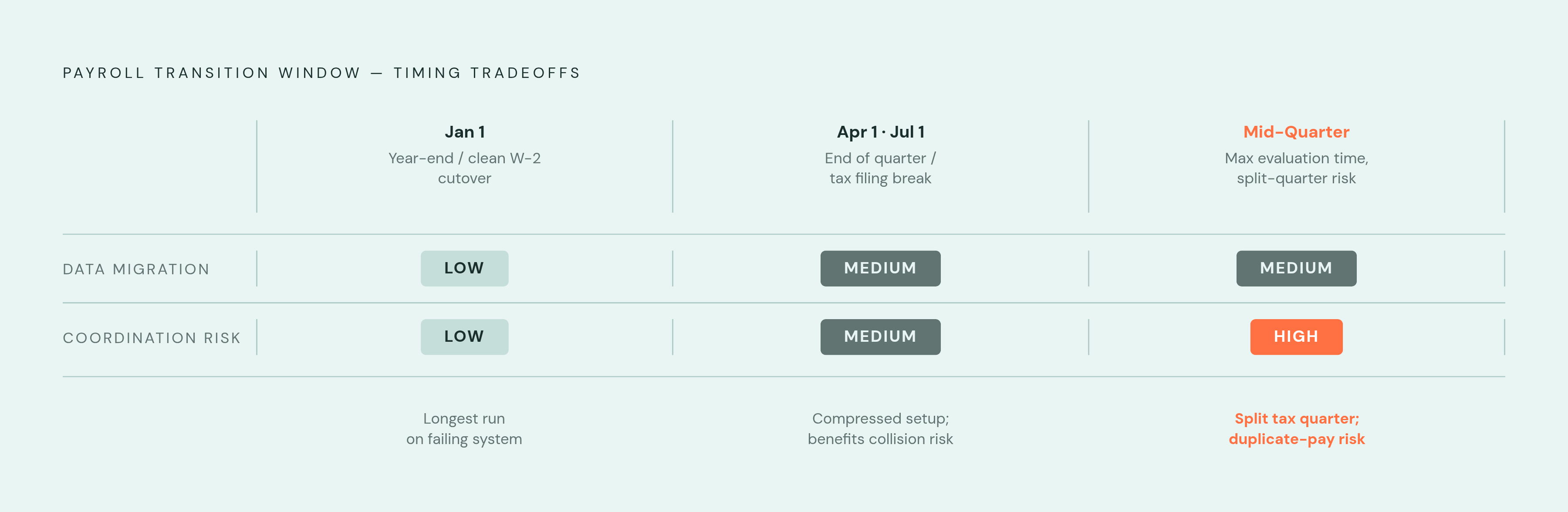
Three windows exist for a payroll transition, and each one trades a different kind of risk for a different kind of relief.
A year-end switch gives you the cleanest handoff on W-2s and tax filings, plus the psychological benefit of a fresh start with a new tax year. But it also means the longest possible stretch spent limping along on a system you've already decided to leave, and it concentrates implementation risk into the highest-pressure calendar period payroll teams face.
Switching at the end of a quarter, April 1 or July 1, for instance, lines up with a natural tax filing break and gives you a full quarter to stabilize before the next one starts. The tradeoff is a compressed window to actually vet and set up the new system, and it can collide with open enrollment if your benefits cycle runs on a similar clock.
A mid-quarter switch, oddly, often gets more real evaluation time than either of the other two options. You avoid the year-end crunch entirely and get the whole second half of the year to fine-tune the new setup. Mid-quarter is also the window with the highest coordination burden, because it requires the outgoing and incoming providers to split tax responsibility inside a single quarter that neither one owns in full.
None of these windows eliminate the migration. They only change how much year-to-date data has to move, and how carefully. A January 1 start requires zero prior pay periods for the current tax year, since nothing has accrued yet. A switch in June or September means every dollar of wages and withholding for that employee, all year, has to transfer accurately before the new system runs its first payroll. Miscount that, and the new provider is calculating taxes off the wrong baseline from day one.
Mid-quarter is the riskiest window specifically because both providers may be actively collecting taxes for the same quarter at the same time, one handling part of it, the other handling the rest. Left uncoordinated, that's the exact setup that produces duplicate tax payments. Most transitions, handled with a real plan, take two to six weeks. Name that range early and work backward from it, because a target go-live date without that runway built in is how transitions turn into scrambles.
What data has to move cleanly
Data errors, not software bugs, are the most common obstacle in a payroll transition. Payroll records accumulate across years, across states, across a mess of deduction types, and every one of those categories has to survive the move intact.
Active employee records need to transfer completely: Social Security numbers, compensation rates, federal and state withholding elections, and both work and residence locations. Year-to-date earnings totals by employee matter just as much, since they directly drive tax calculations and W-2 reporting for the rest of the calendar year. Deduction balances, benefits premiums, 401(k) and HSA contributions, wage garnishments, all have to carry over precisely, alongside prior quarterly filing records (Form 941 history) and the employer's tax IDs and state tax account numbers.
Before any of that moves, it needs cleaning. Duplicate employee profiles, deduction codes nobody uses anymore, earning codes tied to positions that don't exist, all of it causes calculation errors in the new system if it gets carried over uncleaned. A new system runs the calculation as instructed even when a code is dead weight. It just runs the calculation as instructed.
Consider an employee who relocated mid-year from a state with no income tax to one that levies it. The new provider needs an accurate record of exactly when that move happened and what the new withholding obligation is from that date forward. If you miss that detail, the very first payroll run under the new system produces a compliance problem, not a hypothetical one, an actual filing error tied to a real employee's real paycheck.
The tax compliance risks specific to a mid-year switch, including the 2026 figures that matter
The IRS assessed more than $1.15 trillion in employment tax penalties in fiscal year 2025. Errors in payroll data and tax coordination are among the factors that contribute to those assessments.
The single most common compliance risk in a mid-quarter switch is duplicate taxation. If the outgoing provider already paid unemployment taxes for the quarter, the incoming provider cannot pay them again, full stop. And the asymmetry here matters: an employee who gets over-withheld for FICA can claim the excess back on their personal tax return. The employer has no equivalent path. A duplicate employer match is just gone.
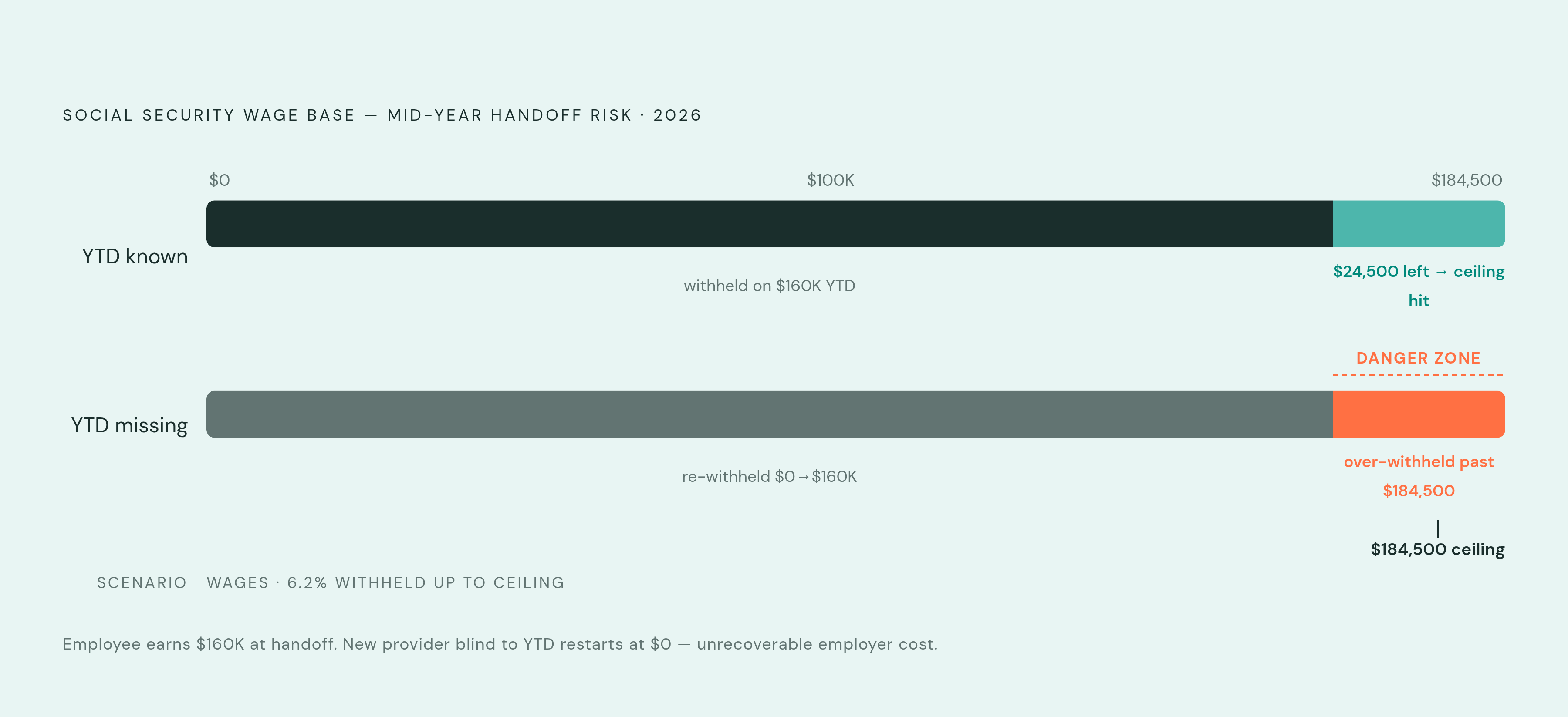
The dollar exposure is specific. FICA costs employers up to 6.2% of wages, up to the Social Security wage base, plus a Medicare match. FUTA costs up to 6% on the first $7,000 of each employee's wages. For 2026, the Social Security wage base rises to $184,500, up from $176,100 in 2025. Employers withhold 6.2% from every employee's wages up to that new limit and match it dollar for dollar, and once an employee's year-to-date earnings cross $184,500, Social Security withholding stops entirely for the rest of the calendar year.
That threshold is exactly where a mid-year switch gets dangerous for higher earners. If the new provider doesn't receive that employee's accurate year-to-date earnings, it has no way of knowing the threshold's already been hit, or how close it is. It restarts withholding from zero. The employee ends up over-withheld and has to claim the excess back at tax time, and the business eats a duplicate employer match it has no way to recover. That's a five- or six-figure mistake for a company with several employees near that wage base. That's a five- or six-figure mistake for a company with several employees near that wage base.
The step-by-step process for a clean mid-year switch
Start by pulling a complete payroll summary report from the current provider before touching anything else. This report should capture the full payroll tax history, year-to-date totals by employee, and every quarterly filing made so far this year. It becomes the foundation for everything downstream: the tax catch-up calculations, any parallel payroll runs, and the history verification the new provider needs to do before go-live.
Next, get written confirmation from the current provider on exactly which taxes have already been paid for the current period. Not a verbal assurance, documentation. That paperwork needs to land in the new provider's hands during the tax catch-up phase, because it's the single step that prevents duplicate payments as described above. If you skip it, you're relying on guesswork to avoid a six-figure tax mistake.
Filing responsibility for the transition quarter needs to be assigned explicitly, in writing, before go-live. Decide who files Form 941 for that quarter: the outgoing provider, the incoming one, or a split by pay period. Decide, too, who issues W-2s at year-end. Consolidating into a single W-2 is possible if the new provider imports the full payroll history, and issuing two W-2s is also acceptable to the IRS, but only if employees are told about it well in advance. What can't happen is double-filing Form 941 for the same quarter, or the mirror-image failure where neither provider files it because each assumed the other would.
Last, clean the data before it migrates anywhere. Strip duplicate employee profiles, retire deduction codes nobody uses, remove inactive earning codes. Verify tax settings actually match each employee's current work and residence location, not last year's. And check Social Security and Medicare year-to-date totals specifically for anyone approaching that $184,500 wage base, since that's the exact spot where an uncaught gap turns into real money.
What to tell employees, and when
Tell employees early, and keep the message factual. What's changing is the platform. What's not changing is their pay date, their pay amount, and their access to their own history.
Before go-live, employees need to know three concrete things: when their first paycheck through the new system will land, how to log into the new self-service portal, and whether they'll receive one W-2 at year-end or two, and why.
The W-2 issue deserves the most care of the three. An employee who receives two W-2s with no warning, or whose tax totals don't match their last pay stub from the old system, doesn't experience that as a technical footnote. They experience it as a reason to worry, even when everything is technically correct and fully compliant. That anxiety corrodes confidence in how the business runs finances generally, and it's entirely avoidable with a two-line explanation sent before the confusion has a chance to set in.
If the switch touches benefits administration as well as payroll, employees need COBRA notices for the plan they're leaving and clear enrollment instructions for the one they're entering. That's a separate compliance track from payroll itself, but it rides along on the same timeline, and it deserves the same advance notice.
How to evaluate whether a new provider can handle what you need
Ask whether a provider has actually handled mid-year transitions, specifically, with the data-transfer and tax-catch-up mechanics that entails. It's whether that provider has actually handled mid-year transitions, specifically, with the data-transfer and tax-catch-up mechanics that entails.
Ask directly: can this provider run multiple pay frequencies inside one organization, weekly for hourly staff alongside semi-monthly for salaried employees? Can it handle multiple pay rates, garnishments, and general ledger integrations without manual workarounds? What's the actual process for tax catch-up and parallel payroll runs during a mid-year move? And who, specifically, takes responsibility for filing Form 941 for the transition quarter, with what documentation to prove the handoff happened cleanly?
Integration matters as much as the payroll math. The new platform needs to connect with existing HR systems, time tracking, accounting software, and benefits administration, because integration failures are one of the biggest headaches organizations run into when they try to get better payroll and workforce reporting out of a new system.
Raise the edge cases upfront, too, before they surprise anyone mid-transition. Shareholder health insurance gets taxed differently from standard W-2 wages. Clergy housing allowances aren't taxable for income tax purposes and W-2 reporting of them is optional, with Box 14 used for informational reporting. And any multi-state workforce needs to be flagged early, particularly with new state-level rules taking effect in 2026 that a provider without multi-state experience may not have built for.
What a clean switch looks like at year-end
A clean switch is visible in the absence of problems, not a list of achievements. One W-2 per employee, or two clearly explained ones, with totals that reconcile to the penny against what both providers actually paid. No duplicate 941 filings for the transition quarter, and no quarter where neither provider filed. No employee opens a self-service portal wondering why their year-to-date numbers don't match the paycheck in their hand.
The real test isn't the first payroll run under the new system. It's whether the transition quarter, viewed in hindsight at tax season, looks like it was handled by one continuous payroll operation rather than two disconnected ones stitched together under pressure. Reconciliation is where that gets proven or disproven: pull the year-end totals, match them against the mid-year handoff documentation, and confirm every dollar of tax liability landed with the provider responsible for it. If that reconciliation takes an afternoon instead of a week, the switch worked.