Payroll Software Pricing Models Explained for SMB Buyers
Four pricing models power payroll software, each with different cost structures.

Payroll pricing looks like a simple equation: a base fee plus a per-employee charge. It isn't. Underneath that two-variable pitch sit at least four structurally different pricing models, each with its own cost drivers, and the moment a buyer tries to line up quotes side by side, the numbers stop meaning the same thing. One vendor's "full-service" plan is another vendor's premium add-on tier. According to Wisemonk's 2026 pricing comparison, add-ons can significantly inflate what looks like a modest base price once a full year of use gets tallied up. Get the model wrong and a business either overpays for bundled services it never touches, or underpays for a plan that cracks the first time compliance gets complicated.
This piece names each model, breaks down what actually drives its cost, and lays out a way to match the right structure to the size and shape of a given business. A few terms show up constantly in vendor materials and deserve quick definitions up front: PEPM means "per employee per month," the unit most payroll vendors price by. PEO stands for "Professional Employer Organization," a co-employment arrangement covered in detail below. EOR means "Employer of Record," a model built for hiring workers in countries where a company has no legal entity.
The four pricing models and what makes each one structurally different
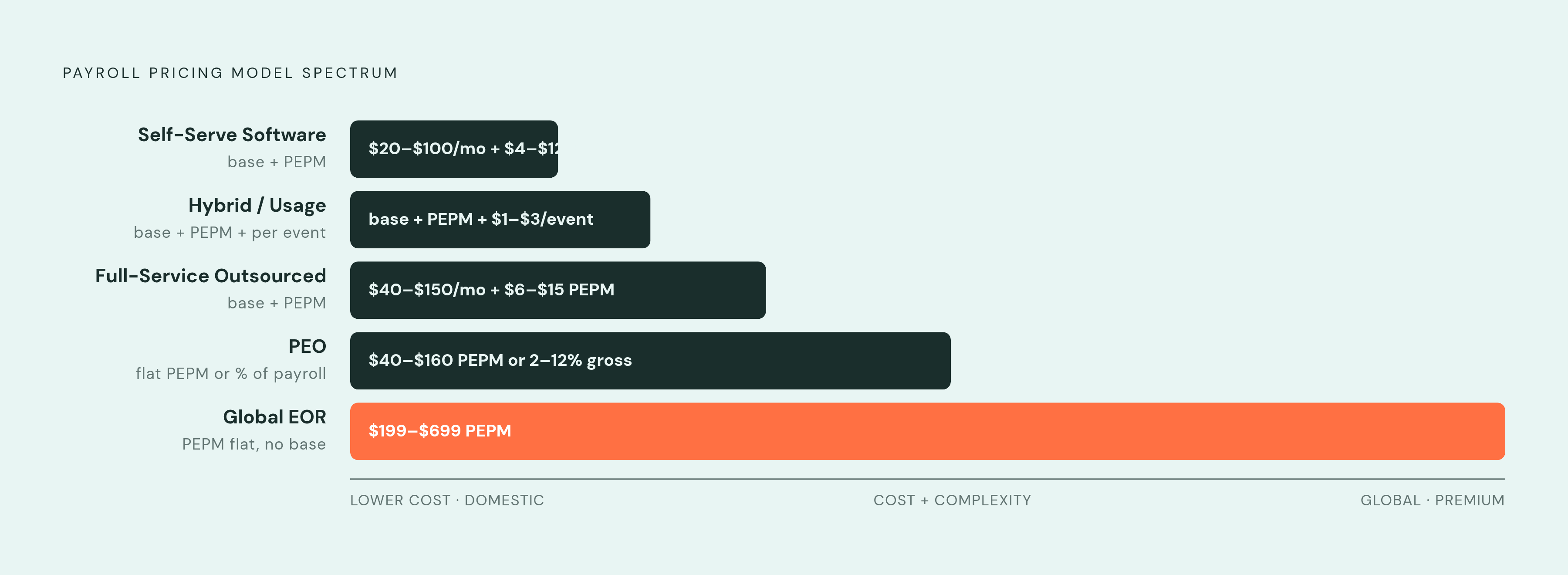
Think of these as four distinct categories, not four rungs on a ladder from cheap to expensive. Each one fits a different kind of business, and picking based on price alone, without checking whether the model matches the operation, is how buyers end up disappointed six months in.
Self-serve payroll software is the DIY model. A business runs it directly, and the software handles the math: tax withholding, calculations, direct deposit. Pricing here is a flat monthly base fee plus a per-employee-per-month charge, and per Wisemonk's 2026 figures, that typically runs between $20 and $100 a month for the base, plus $4 to $12 per employee. The base fee pays for platform access. The per-employee charge reflects actual processing work, so cost scales linearly with headcount. That's predictable at 10 employees and worth watching closely once a company crosses into the dozens.
Hybrid or PEPM pricing with usage fees has become more common as vendors bolt analytics, multi-state tax automation, and third-party integrations onto their core product. It's a three-part cost structure: base fee, PEPM charge, and usage-based fees for specific events like off-cycle payroll runs or bonus processing. Lift HCM's 2026 data puts those usage fees at roughly $1 to $3 per event. Industry forecasts point to a 3 to 6 percent price increase across 2026 as platforms fold compliance tools into their core packages. The risk with this model is that usage fees rarely show up in headline pricing, so a business running frequent off-cycle payrolls, say, for commission adjustments or contractor bonuses, gets surprised at the invoice stage.
Outsourced, full-service payroll hands the entire process to a provider: tax filing, compliance, direct deposit, all of it. Per Wisemonk, pricing runs $40 to $150 a month as a base, plus $6 to $15 per employee. It's worth drawing a hard line here between this and a PEO. A full-service payroll provider manages payroll and tax reporting, while a PEO bundles payroll with HR, benefits, and compliance under one co-employment arrangement. Full-service payroll is the middle rung, built for businesses that have outgrown spreadsheets and DIY tools but aren't ready for the deeper commitment a PEO requires.
PEOs work through co-employment: the PEO becomes the employer of record for tax and insurance purposes, while the business retains day-to-day management of the team. Wisemonk's 2026 data shows two pricing structures here, flat PEPM running $40 to $160 per employee per month, or a percentage of gross payroll, typically 2 to 12 percent. The percentage model tracks salary levels rather than headcount alone, so a 20-person team of engineers costs more under this structure than a 20-person team of retail associates. PEO services also come bundled. Payroll, HR, benefits administration, and compliance travel together, and a business can't peel off just the piece it needs. The scale of demand for this model is notable: the global PEO market is projected to grow from $81.75 billion in 2026 to $189.76 billion by 2034, according to Straits Research figures cited by Riseworks. That's a real signal of employer appetite, not a marketing claim.
Global EOR services are aimed at companies hiring workers internationally without setting up a local legal entity. These are priced per employee per month with no base fee at all, running $199 to $699 per employee per month per Wisemonk's 2026 numbers. Most domestic SMBs will never touch this model, but knowing it exists keeps the pricing from looking like a typo when it crosses a reader's desk.
What named platforms actually charge in 2026
Even within a single pricing model, published rates vary more than the marketing pages suggest. None of what follows ranks one platform above another; each serves a different kind of buyer.
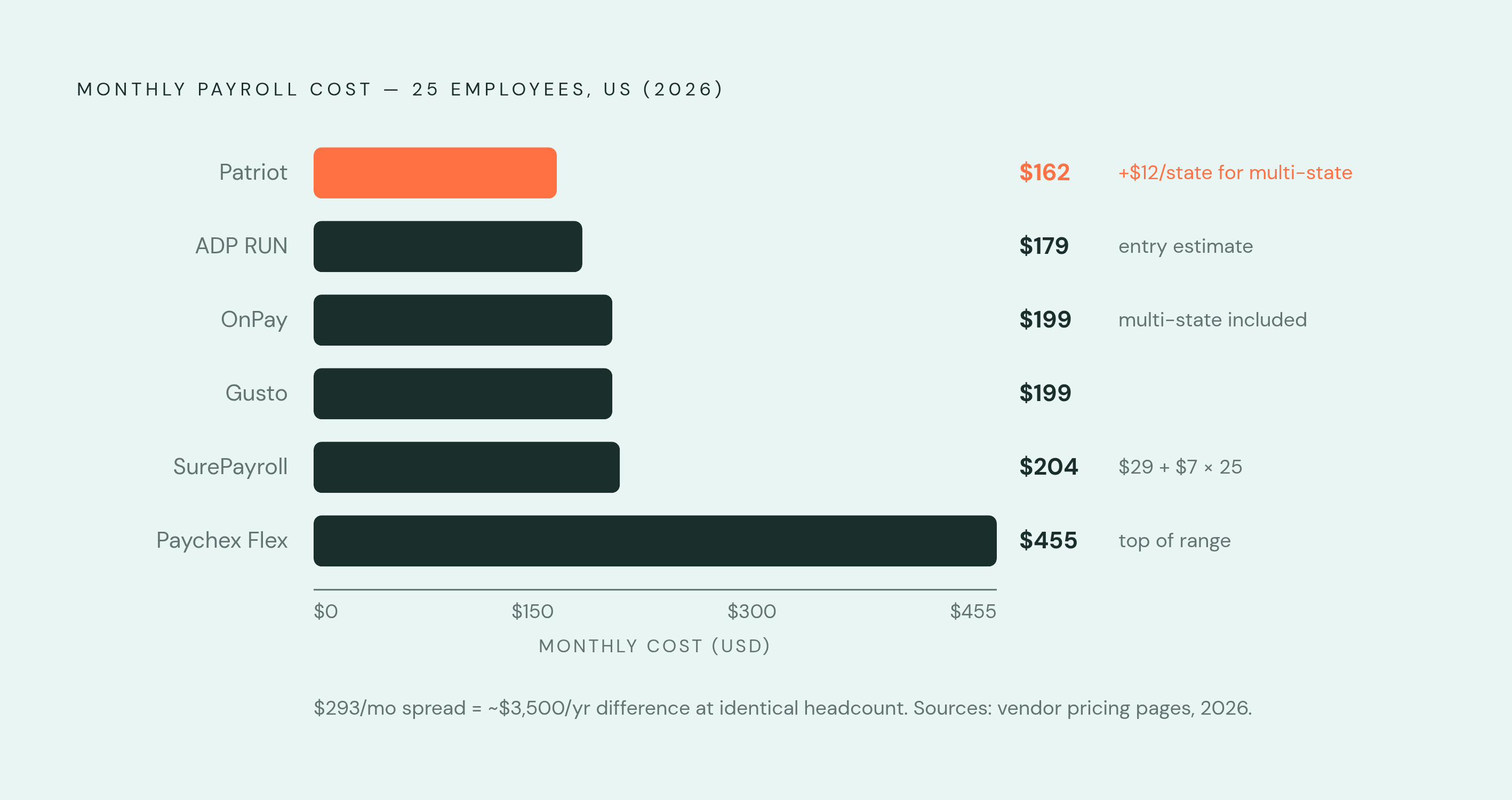
Gusto Simple starts at $49 a month plus $6 per employee. A 10-person team is around $109 a month. Moving up to the Plus plan for a 50-person team brings the bill to roughly $680 a month before optional add-ons like priority support, broker integration, or tax-advantaged benefits administration.
OnPay charges $40 a month plus $6 per employee, though some published sources list the base at $49 a month, so both figures should be carried with the discrepancy noted. OnPay runs a single core plan rather than a tiered structure, though certain HR features require paid add-ons. Multi-state payroll comes included at no extra charge. For a 25-person team, OnPay runs $199 a month, the same as Gusto at that headcount, but OnPay's price holds steady across state lines while Gusto's doesn't.
Patriot Payroll publishes the lowest rate among major platforms: $17 a month plus $4 per employee, with both DIY and full-service tiers priced low. A 25-person team costs $162 a month, undercutting both Gusto and OnPay at that size. But Patriot charges $12 a month per additional state for multi-state tax filing, a cost that erodes the headline advantage for any business operating across state lines.
SurePayroll's full-service plan runs $29 a month plus $7 per employee. Its year-end W-2 and 1099 forms get billed separately, at $50 base plus $5 per form, a cost that lands right at tax season when businesses are least prepared to absorb a surprise line item.
ADP RUN's published entry point is $79 a month plus $4 per employee, with full-featured plans typically running $130 to $180 a month. ADP doesn't officially confirm these figures; the widely cited entry-level number is a third-party estimate, and actual pricing requires a custom quote from the company.
Paychex Flex packages typically start around $39 a month plus $5 per employee, though again, actual pricing requires a custom quote. Paychex pricing scales with payroll frequency, which means businesses running weekly payroll or issuing frequent off-cycle runs face materially higher costs than the base rate implies.
For a 25-person US business shopping across these platforms, SaaSRat's 2026 data puts the range at $162 to $455 a month, a gap wide enough to change a company's software budget by thousands of dollars a year depending on which box gets checked. The multi-state question alone accounts for a meaningful chunk of that spread: OnPay includes multi-state at no charge, while Gusto's $12-a-month-per-state fee adds up to $288 a year for a company operating in three states. Patriot beats both on headline price at $162 a month, but multi-state filing support varies by plan, so feature scope has to get weighed alongside price rather than after it. Neither ADP nor Paychex publishes standard rates: value-focused providers keep their PEPM numbers visible and low, while the larger enterprise names price by custom quote instead.
The fees that don't appear in the headline price
A modest base plan can cost significantly more once a year of add-ons gets included, per Wisemonk's 2026 analysis. The headline price is a floor, not a ceiling.
A handful of charges account for most of the gap. Setup fees hit once, at account configuration, and the range depends heavily on provider and plan tier. Year-end form processing catches many buyers off guard: some providers charge per W-2 or 1099 form at tax time, and SurePayroll's structure, $50 base plus $5 per form, shows how fast that adds up for a business with a dozen contractors. Off-cycle payroll runs, bonus runs, correction runs, weekly pay cycles, carry per-run fees on some platforms, and Paychex's frequency-scaled pricing makes this cost especially visible on a monthly statement. Multi-state filing gets handled three different ways across the market: Gusto charges $12 a month per additional state, and OnPay folds it into the base price. Timekeeping and attendance add-ons run $2 to $6 per employee per month on most cloud payroll platforms, per 2026 cost guides. HR features like onboarding paperwork, benefits administration, and policy libraries usually sit locked behind a pricier tier. And garnishment processing, when a business needs to withhold wages for a court order, is often a separate fee that headline pricing pages skip.
A comparison between two named payroll providers makes the point cleanly. Published platform comparisons note that OnPay bundles tax filings and multi-state payroll into its base price, while other platforms treat some of these as add-on charges. Same pricing model on paper. Very different total cost once a year of real use gets factored in.
The practical fix is straightforward: request an itemized quote before signing anything, one that spells out year-end form fees, off-cycle run charges, and garnishment processing costs in writing, per Fridayapp's 2026 buyer guidance. This matters more now than it used to. Industry research from 2026 indicates that a substantial share of HR leaders expect payroll costs to rise, placing it among the top rising HR expenses businesses are tracking. Total cost scrutiny isn't a nice-to-have anymore.
How compliance changes are pushing 2026 prices upward
Compliance complexity costs payroll vendors real money to keep up with, and vendors pass that cost straight through to buyers. Two changes landing in 2026 illustrate how that happens.
The Social Security wage base climbed to $184,500 in 2026, up from $176,100 in 2025. That increase raises the ceiling on taxable wages, which adds calculation complexity on the employer side for every payroll run above the old threshold, per Wisemonk's 2026 analysis. Separately, more than a dozen states plus one additional jurisdiction. now require Paid Family Medical Leave contributions. Each of those programs adds its own withholding calculation and its own remittance obligation, and none of them work identically to the next state over.
Vendors are responding by building compliance tools and AI automation into their core packages rather than selling them as separate add-ons, and Industry forecasts cited by Lift HCM expect base fees to tick up slightly as a result. Multi-state operation compounds the problem further: every state a business operates in requires its own tax registration, its own unemployment insurance account, and its own withholding rules. Businesses spanning three or more states should prioritize providers with proven multi-state infrastructure already built, not platforms that treat multi-state support as an afterthought bolted onto a domestic product.
One question belongs in every vendor conversation: does the current plan price include compliance updates, like new state PFML requirements or wage base changes, or does keeping current require an upgrade to a pricier tier? A plan that looks affordable today can force a tier upgrade twelve months from now just to stay compliant, and that future cost belongs in the total-cost-of-ownership math now, not as a surprise later.
Matching the right pricing model to your business situation
Three variables drive the decision: headcount, operating complexity (how many states, what pay types, what compliance obligations), and how much time the business is willing to spend running payroll itself rather than paying someone else to run it.
Self-serve software fits businesses with fewer than roughly 25 W-2 employees, operating in one or two states, without group health benefits to administer. Low workers' comp risk helps too, along with the absence of tipped employees or multiple pay rates that complicate the math. This model works best for teams that are price-sensitive on monthly overhead and comfortable managing the platform directly rather than handing it off. Solid options at this stage include Gusto, OnPay, Patriot Payroll, and ADP RUN. A cheap tool stops being cheap the moment a team spends hours a month fixing bad data, chasing approvals, or working around a missing feature.
Full-service, outsourced payroll fits the businesses that have outgrown DIY, usually because compliance complexity or headcount growth has made the spreadsheet approach unsustainable, but that don't need the full bundle a PEO requires. It's the right call for a business that wants payroll off its plate entirely without taking on co-employment. A practical middle-ground path here is either an accountant-managed payroll arrangement or a dedicated full-service provider.
PEOs make sense once a business hits a scale where integrated HR, benefits, and compliance support justifies the bundled cost. Wisemonk cites 25 or more employees as the typical threshold where the PEO math starts working, and notes that outsourcing generally beats in-house payroll management above roughly five employees. PEOs also give smaller businesses access to benefits purchasing power they couldn't negotiate alone, since the PEO pools coverage across all its client companies. The growth numbers back up the appeal: a February 2026 NAPEO survey found PEO clients reported an 80 percent business growth rate in 2025, compared to 67 percent for companies that skipped the model. That's context, not a sales pitch, but it's hard to ignore. Within the PEO category, flat PEPM pricing is predictable regardless of what the team earns, while percentage-of-payroll scales directly with salary costs, a real consideration for any business built around high-wage roles.
A few situational calls round this out. Per HRPayPick's comparison, a typical office-based SMB fits naturally with Gusto. Businesses juggling tipped employees, multiple pay rates, or nonprofit-specific compliance needs tend to fit better with OnPay, given its included multi-state support and its handling of pay structure variety without pushing those features into a pricier tier.