The Best Payroll Software in 2026: Our First Picks
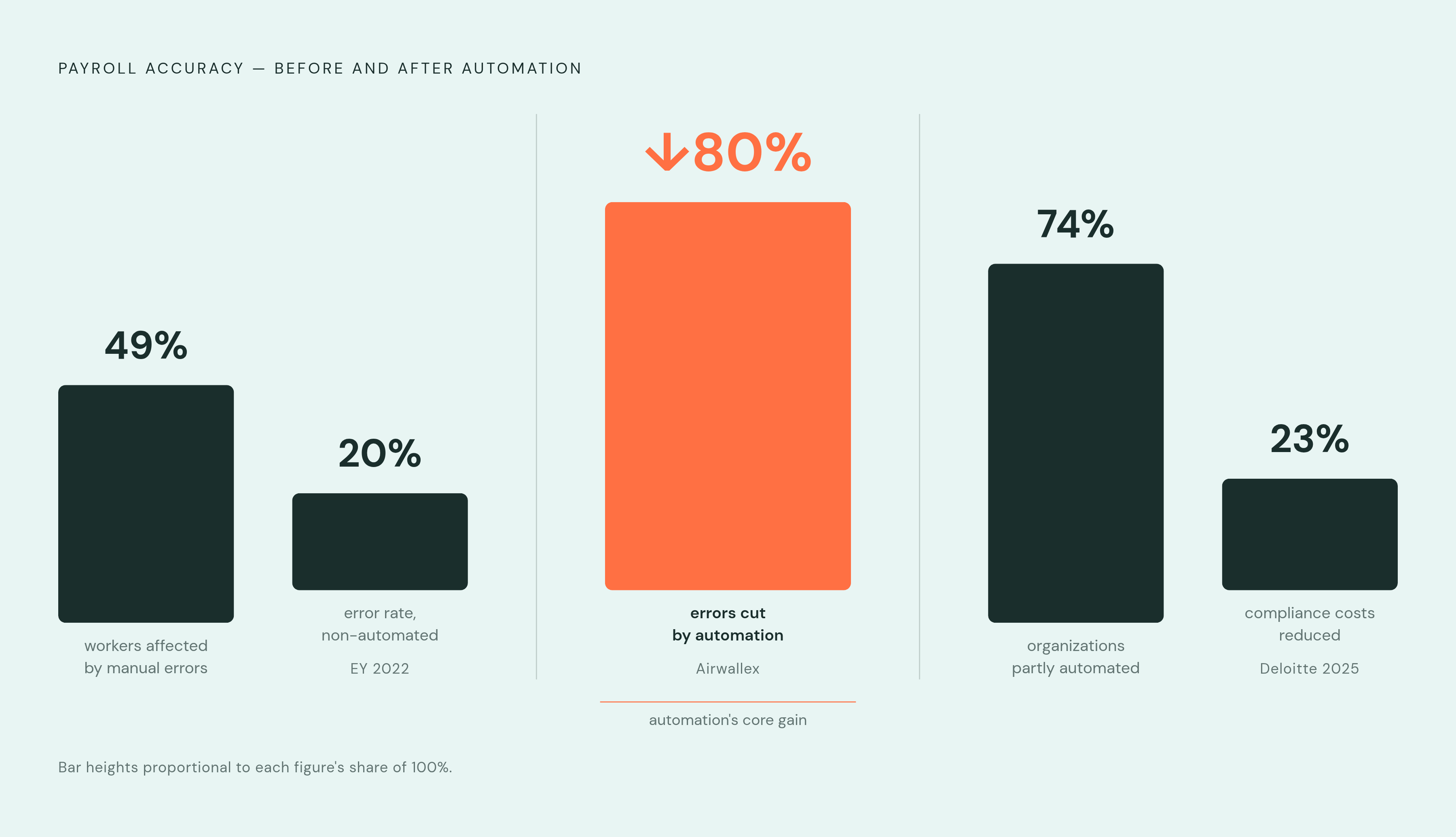
Automation cuts payroll errors by up to 80 percent and slashes compliance costs by a quarter.
One in five payroll cycles still contains an error. Manual payroll mistakes touch nearly half of all workers, roughly 49%, which means the problem is widespread and not confined to badly run companies. It's structural. Several vendors report average payroll accuracy rates around 78%, and that's with software already in the loop. Take the software out, and the picture gets worse: EY's December 2022 analysis found that organizations running traditional, non-automated payroll faced error rates near 20%.
Compliance adds another layer of pressure. Heading into 2026, 60% of HR professionals cite compliance as an active challenge, and that number keeps climbing as state and federal labor rules shift under their feet. Automating payroll cuts processing errors by as much as 80%, according to Airwallex's analysis, and 74% of organizations have already automated at least part of the process. So the real question companies face is when and how to automate. It's which platform earns the trust to do it.
A 2025 Deloitte survey found that companies using predictive payroll tools cut unexpected compliance costs by 23%. Automation also shortens payroll close time by 20 to 50 percent, freeing up finance staff who'd otherwise spend days reconciling discrepancies by hand. None of this is a rounding error. A platform that looks cheap on the invoice but generates fines, back pay, or angry employees is actually expensive. It's a deferred cost with interest attached.
The four criteria that separate good payroll software from the right one
Pricing transparency. As of June 2026, Gusto publishes pricing for its core plans, while Deel publishes pricing for EOR and other core products but requires a custom quote for domestic payroll and certain configurations. Rippling publishes a base platform fee, then quotes modules separately. ADP doesn't publish list pricing at all; any number you see in a review is merely a third-party estimate rather than a confirmed rate. That opacity isn't just an inconvenience. It affects budget planning and contract risk: ADP RUN contracts can carry multi-year terms with early-termination fees, so a bad guess on price compounds into a bad long-term commitment.
Compliance coverage. Domestic reach and global reach are not the same product category, and treating them as interchangeable is where a lot of buyers go wrong. Deel covers more than 150 countries. Rippling handles EOR or direct employment in over 160. ADP supports payroll operations across 140 countries. Patriot Software and OnPay, by contrast, are built for domestic payroll. employers only, and don't pretend otherwise. Even inside U.S.-only operations, multi-state complexity separates the platforms: some restrict multi-state tax filing to higher-priced tiers (Gusto does this), while OnPay includes all 50 states in its single flat rate.
Ease of use. A confusing interface doesn't just frustrate the payroll administrator, it generates its own error rate, since rushed or misunderstood inputs are exactly how payroll mistakes happen in the first place. Rippling executes a payroll run in about 90 seconds. Gusto is widely recognized for a clean, modern interface. ADP's tools, built up over decades and multiple acquisitions, can feel more fragmented by comparison, spread across separate logins and dashboards depending on which product a company uses.
Scalability. The question isn't how many employees a company has today, it's where that number is headed. A platform that fits a 10-person team can turn into a migration headache at 100 employees, and migrations mid-year are exactly when payroll errors spike. The payroll run model matters here too: Patriot, Gusto, and OnPay all offer unlimited payroll runs at flat rates, while Paychex charges per run, a structure that punishes companies running weekly payroll or handling frequent off-cycle corrections.
A fifth factor is emerging fast enough that it deserves mention on its own: AI depth. Agentic AI systems in 2026 are starting to flag anomalies, reroute exceptions, and apply new regulatory changes without a human initiating the fix. Some platforms have built this into the core workflow. Others have bolted on an "AI" label without much underneath it, and the difference matters more than the marketing copy suggests.
Best for small businesses that want simplicity: Gusto
Gusto holds a 4.6 out of 5 rating on G2, and it's built for small to mid-sized businesses that want a modern payroll and HR experience without a steep learning curve. As of July 2026, pricing runs three tiers: Simple at $49 a month plus $6 per employee, Plus at $80 a month plus $12 per employee, and Premium at $180 a month plus $22 per employee. Notably, the Simple plan jumped from $40 to $49 a month back in March 2026, so anyone budgeting off an older review needs to recheck the current number. There's also a contractor-only plan at $35 a month, and contractor payments on standard plans cost $5 per payment.
The strengths are real: AutoPilot automates pay runs, direct deposit lands next-day or in two days depending on setup, and benefits administration covers both health and retirement. Payroll runs are unlimited, and the interface is consistently cited as one of the easier ones to learn.
The limits show up fast for growing companies, though. Multi-state tax filing is restricted on the base tier, meaning the moment a business adds a second state, it needs the Plus plan at minimum. Health and retirement benefits are only available in 38 states on certain plans, and live support access varies depending on which tier a company pays for. On the global side, Gusto supports contractor payments in more than 120 countries and offers EOR services through a partnership with Remote, but coverage is limited to a small number of countries, and Gusto is not a standalone EOR provider. Businesses that need to put full-time employees on payroll internationally will outgrow it.
Best value for lean operations: Patriot Software and OnPay
Patriot Software holds a 4.8 out of 5 rating on G2 and undercuts nearly every competitor on price. As of July 2026, Basic Payroll runs $17 a month plus $4 per employee, and Full Service Payroll runs $37 a month plus $5 per employee, the lowest entry point of any platform covered here. Free USA-based support comes standard, and the platform includes unlimited payroll runs, direct deposit, multi-state payroll, and contractor payments. The tradeoff is scale: Patriot isn't built for businesses above 500 employees, its integration options are more limited, and it handles domestic payroll. payroll only, with no support for international payroll.
OnPay, also rated 4.8 on G2, takes a different angle: one flat plan at $49 a month plus $6 per employee, with tax filings for all 50 states included. OnPay is a natural fit for multi-state employers, agricultural operations, and nonprofit organizations juggling complex filings.
OnPay's gaps are specific rather than broad. There's no native time-clock tool. Automated pay runs currently only work for salaried employees (an auto-pay option for hourly workers is rolling out), so hourly payroll still needs manual initiation each cycle. There's also only one plan, meaning no upgrade path inside the platform if a company's needs change, and no direct global payroll support.
What both platforms share matters more than what separates them: unlimited payroll runs at a flat monthly rate. For any business running payroll weekly, or one that regularly needs off-cycle corrections, that structure alone can save real money compared to per-run pricing.
Best for unified HR, IT, and payroll in one system: Rippling
Rippling carries a 4.8 rating on G2, and its core pitch is unification: one dashboard handles payroll, HR, IT, and device management, all built on a single employee database. New hire paperwork and laptop provisioning happen at the same time, in the same system, which is a genuinely different architecture than bolting payroll onto an HR tool or vice versa.
Payroll runs in around 90 seconds. Global payments support multiple currencies, and Rippling supports contractor payments and global employment across a broad range of countries. Beyond payroll, Rippling offers HRIS, benefits administration, device management, app provisioning, identity management, spend management, time tracking, and workflow automation, each priced as its own module.
That module structure is also the catch. Rippling publishes a base platform fee, but every additional module gets quoted separately, and total cost climbs fast for a company that activates several of them. Compared to Gusto, Rippling is more expensive, full stop, but the comparison only makes sense for companies that actually want HR and IT running through one system of record. For those companies, the module pricing reflects real functionality. For a five-person shop that just needs payroll, it's overbuilt, and the implementation complexity and compounding module costs will feel like friction rather than value.
Best for scalable compliance and enterprise complexity: ADP
ADP pays one in six workers in the United States, and that scale is the whole argument for choosing it: no other platform in this roundup has processed payroll compliance data at that volume for as long.
ADP splits into three relevant products depending on company size. ADP RUN targets small to mid-sized businesses, with third-party estimates putting the starting price around $79 a month plus $4 per employee (confirm this by direct quote, since ADP doesn't publish it). Time tracking, benefits administration, and HR support are add-ons, and contracts often run 36 months with early-termination fees attached, making signing one a real commitment beyond a month-to-month trial. RUN's G2 rating is not confirmed in available sources. ADP Workforce Now serves companies in the 50 to 999 employee range and includes AI-powered anomaly detection built to catch errors before paychecks go out, combining payroll, HR, time tracking, benefits, and talent management into one platform. ADP Lyric HCM, aimed at large enterprises, folds in payroll, HR, benefits, talent management, and analytics and benchmarking, priced through custom quotes only.
Globally, ADP supports payroll and compliance operations in 140 countries, and its data platform spans 1.1 million clients and 42 million wage earners worldwide. More than 75 years of accumulated payroll data underpins its compliance engine, a genuine advantage for businesses navigating layered state tax codes, SUI tax rules, or international labor law. The tradeoffs are the ones you'd expect from a company this size: pricing requires a custom quote rather than a published rate, the interface can feel fragmented across products built at different points in ADP's history, and integration setup takes real effort. ADP's own 2026 roundup of large-business options names Paycom, Paycor, Paylocity, UKG, and Dayforce as runners-up in its category.
Best for global teams and international hiring: Deel
Deel carries a 4.8 rating on G2 and is built specifically for companies paying employees and contractors across borders. As of July 2026, Deel charges a flat $49 per person per month for global teams, and domestic payroll is priced separately through a custom quote. Contractor-only plans are available separately.
The EOR structure is the whole point: it lets a company hire full-time employees in over 150 countries without setting up a legal entity in each one, which is normally the single biggest barrier to international hiring. Deel also offers integrated payroll analytics and lets companies manage payroll by entity across multiple geographies from one place.
There's a specific use case worth calling out here too: staffing agencies. Deel lets agencies move past traditional placements into integrated workforce management, supporting a shift toward Managed Service Provider models that opens new revenue streams and, in theory, strengthens client retention. The tradeoff shows up for domestic-heavy companies. Deel's per-person flat pricing is less cost-efficient than per-employee domestic platforms once a workforce is large and mostly domestically based, and global EOR coverage carries a real premium over straightforward domestic processing.
Best AI-driven payroll for mid-market domestic businesses businesses: Paycom
Paycom appears in ADP's own large-business comparison, and it is recognized for its AI tooling for mid-sized domestic businesses. organizations. Beti, its flagship AI feature, builds the payroll, flags issues, and walks employees through fixing them before the payroll cycle closes, which means error reduction is built into the workflow itself rather than added as a checklist step afterward.
Direct Data Exchange uses real-time analytics to surface process inefficiencies, and Manager on the Go gives supervisors mobile access to handle approvals and workforce tasks without being at a desk. All of it sits inside a single-database architecture that covers recruiting, onboarding, time tracking, performance management, and payroll, unifying the entire employee lifecycle rather than stitching separate tools together.
Paycom's approach lines up with where agentic AI in payroll is heading generally: systems that handle multi-step tasks on their own, flagging anomalies, rerouting exceptions, applying new regulatory rules without a person triggering each step. Beti counts as one of the more mature versions of that idea currently running in a mid-market platform. Its limits are geographic: per ADP's own comparison, Paycom's global payroll coverage is more limited than ADP's 140-country reach, and global payroll is listed as not offered in that comparison at all.
Best for enterprise-grade analytics and global scale: Workday
Workday is built for large enterprises that need payroll, compliance automation, workforce planning, financial management, and analytics running inside one cloud system rather than stitched together from separate vendors. Its global payroll framework integrates with systems across more than 180 countries, the widest geographic footprint of any platform in this roundup.
AI runs across payroll, HR, and finance functions inside Workday, and at this scale that's not a nice-to-have. Enterprise data volumes are large enough that automated anomaly detection and predictive analytics become the only realistic way to catch problems before they surface in a paycheck or a compliance filing. For a company already running Workday's other modules, folding payroll into the same system removes a layer of integration work that smaller, single-purpose platforms simply weren't built to handle.