Deel vs Remote for International Contractor Payroll
Legal liability determines which platform protects your business when contractor disputes arise.
International contractor payroll now runs through platforms, not spreadsheets, and the choice between Deel and Remote comes down to a single question: who holds legal risk when a contractor relationship goes sideways. The two companies started from opposite theories about what "global payroll" should even mean, and those theories still shape their pricing, their entity structure, and how much work lands on your ops team. Get the fit wrong, and you're either overpaying for automation you don't need, or absorbing legal exposure you never priced in. Deel alone processes $22 billion in annual payroll across more than 150 countries, so the stakes here aren't academic.
This piece sticks to international contractor payroll specifically, not full employer-of-record hiring for direct employees, and it's built as a decision guide organized by company situation rather than a scored review. Pricing, entity ownership, and support gaps determine who's liable when a misclassification claim appears, how fast you can add a new country, and how much of that burden your team absorbs versus hands off to the platform. One of these platforms is the safer default for most companies hiring across borders right now, for the following reasons.
What each platform is (and the founding philosophy that shaped it)
Deel started as a tool for paying contractors and grew into something closer to a full workforce operating system. EOR, contractor management, global payroll, an HRIS, device management through Deel IT, immigration support, benefits, recruiting, workforce planning: it's all under one roof now. The company serves more than 37,000 customers and closed a large Series E in October 2025 that pushed its valuation into multibillion-dollar territory.
Deel got there by buying capability. Multiple acquisitions in recent years, including Safeguard Global's payroll division and Zavvy, each one folded into the platform rather than left to run on its own. The logic is straightforward: widen the surface area, buy what you can't build fast enough, and fold it all into one dashboard so a customer never has a reason to leave.
Remote took the opposite bet, and it's the sounder one for anyone hiring in a country with aggressive labor enforcement. Founded in 2019 by Job van der Voort, formerly VP of Product at GitLab, and Marcelo Lebre, formerly VP of Engineering at Unbabel, the company chose to own its legal entities outright rather than lean on local partners, and to keep the product narrow instead of chasing every adjacent HR function. Compliance defensibility mattered more to Remote's founders than ecosystem breadth, and that choice appears in every part of how the product works today. Remote's January 2026 acquisition of Atlas, which added global employee cards, a points-based perks system, and integrated global healthcare, shows the company isn't allergic to growing. But the pace and the selectivity still look nothing like Deel's, and that restraint is the point.
The two approaches answer different questions about what "reducing payroll risk" actually means. Automate and integrate everything, or own the legal relationship directly and keep the product simple enough that nothing gets lost in translation. Depending on where you're hiring, one of those answers matters a lot more than the other: for companies hiring into countries with active labor enforcement, Remote's answer is the one that holds up under an audit.
How contractor pricing compares once you account for what's not in the headline
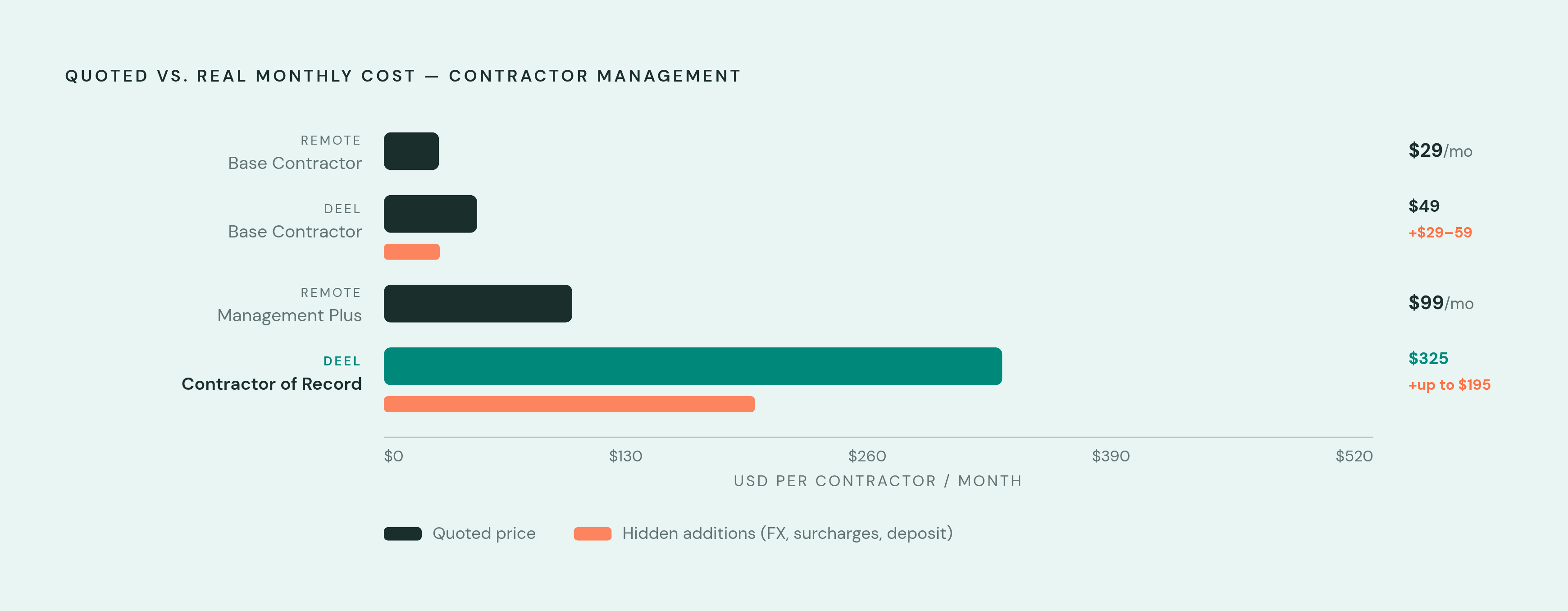
On the surface, Remote is cheaper. Its base contractor management rate runs $29 per contractor per month. Deel's equivalent runs $49 per contractor per month. On that number alone, Remote wins for anyone counting pennies across a large contractor roster.
But the headline rate isn't the full cost, and on some tiers it isn't close. Deel's Contractor of Record product, priced at $325 a month, transfers misclassification liability directly onto Deel. Enforcement against contractor misclassification has picked up sharply in Spain, the Netherlands, and California since 2024, and for a company hiring in those markets, $325 a month to hand the legal exposure to someone else is a straightforward insurance calculation against a real and rising chance of getting audited.
Remote answers the same problem at a lower price point. Its Contractor Management Plus tier, at $99 per contractor per month, adds misclassification safeguards, indemnity coverage, and compliance support beyond the base plan. It isn't identical to Deel's full liability transfer, but it sits in the same lane at roughly a third of the cost, and for most mid-sized teams that's the better trade, not just the cheaper one.
What Deel's pricing page leaves out adds hidden costs that don't appear in what it lists. A one-month salary deposit required upfront, an FX markup of 0.6 to 2 percent, and monthly surcharges of $50 to $150 in markets like Brazil, France, and India, where local compliance work runs heavier, appear only after signup rather than on the pricing page. Stacking those together pushes the real monthly cost on Deel to 30 to 60 percent above the number quoted on the pricing page. Remote, by contrast, does not require the same upfront salary deposit, a real working-capital advantage for a smaller team that doesn't want a month of payroll frozen in an intermediary account.
Neither platform wins on price. Remote wins for a lean, low-complexity contractor base. Deel wins for teams that need someone else holding the liability in markets where regulators are actively looking, and are willing to pay for that transfer. Anyone comparing the two on the headline number alone is comparing the wrong figure.
What happens to liability when something goes wrong under each entity ownership model
Remote owns its legal entity in every country where it operates. No local partner sits between the company and the contractor relationship. When something breaks, a termination dispute, a compliance inquiry, an emergency pay correction, the accountability chain runs straight to Remote with nobody else in the loop.
Deel's structure is more layered, and this is where the marketing gets ahead of the mechanism. Deel owns roughly 250 entities across more than 100 countries, a genuinely large footprint, but in markets where it hasn't set up its own entity, it works through local partners instead. "Deel operates in 130-plus countries" and "Deel owns the entity in the country you're hiring in" are two different claims, and the gap between them is exactly where liability questions get complicated during a dispute. Anyone signing up should ask for the specific list of owned versus partner countries that matches their hiring plan, in writing, before the contract is signed.
Both companies have built software to manage the same underlying risk in different ways. Remote runs a Compliance Watchtower that tracks legal changes country by country, monitored by its in-house legal team, alongside Remote IP Guard, which automates intellectual property protection, transfers, and moral rights waivers where local law allows it. Deel built a Worker Classifier, an AI tool aimed at catching misclassification risk before it becomes a legal problem, plus an AI Assistant that answers compliance questions in real time.
Remote leans on external in-country partners to actually distribute salary payments in many countries. That's a different question from entity ownership, but it can cut into visibility on payment status and introduce delay, which matters if you're running contractor payroll on tight timing.
On security certification, both platforms clear the standard bar: SOC 2 and GDPR compliant across the board. Deel's own documentation lists SOC 1, SOC 2, SOC 3, ISO 27001, and GDPR compliance across the board. But certification breadth doesn't answer who owns the entity, a fact that contract and incorporation records establish separately. That question gets settled separately, by contract and incorporation records, not by which certifications a vendor holds.
What Deel's ecosystem depth enables and where Remote's focus pays off
Deel's integration list runs deep, covering major payroll, HR, finance, and IT platforms, with more than 150 integrations in total. Its no-code Workflow Builder lets an ops team automate multi-step processes without pulling in engineering, and an open API with webhooks covers whatever the Workflow Builder doesn't. Early 2026 brought Workday Global Payroll Cloud certification, cutting out a chunk of manual reconciliation work for finance teams already running Workday.
Remote reached its own Workday Certified Integration status in August 2026, giving Workday customers a real connection path. But the automation layer behind it is thinner. Remote's integrations and workflow tools handle straightforward cases well, without matching the depth of Deel's Workflow Builder once things get more elaborate.
Deel also rolled out a set of named AI agents in August 2025, each built for a specific HR or compliance task: Hiring Guru, PTO Fairy, Border Buddy, Schedule Sheriff, IT Guy, Goodbye Genie, Payroll Detective. Playful names aside, the idea is to automate specific chunks of work, immigration paperwork, PTO tracking, offboarding, rather than have one generic assistant try to do everything. The tradeoff for all that surface area is a real onboarding curve: new users sometimes need close to a week before they're comfortable navigating the full dashboard, which spans EOR employees, contractors, payroll, HRIS, IT devices, and immigration in one place.
Remote's narrower lane pays off in specific spots, with self-service tools and compliance features that are well-suited to international employee and contractor management. Its self-service tools for payslips, leave requests, and expense tracking get consistent praise on G2, and the interface is clean enough that smaller ops teams tend to ramp faster. Deel ships a mobile app; Remote's mobile offering is more limited. On support responsiveness, a gap that matters most during a payroll incident that needs fixing in the next hour, not the next email cycle, the platforms differ in the channels and speed they offer.
How much that surface area matters depends entirely on how the team is staffed. A three-person ops team managing 40 contractors across 12 countries absorbs Deel's full feature set very differently than a 15-person team managing 400 contractors across 30. For the smaller team, Remote's narrower footprint is the entire appeal. It's the entire appeal.
Recurring friction points reported by real users on each platform
Deel's most consistent criticism centers on fee transparency. G2 reviewer Xavier M., writing in January 2026, flags friction around withdrawal fees and FX markups specifically, and those hidden costs appear in real complaints rather than sitting quietly in fine print. Anyone evaluating Deel should ask for a complete fee schedule, FX markup included, before signing anything. Separately, some reviewers report payroll errors averaging more than one issue a month, a pattern that raises a due-diligence flag even without a clear structural explanation behind it.
Remote's recurring complaint runs the other direction: inconsistent support responsiveness. G2 reviewer Akhil V., also writing in January 2026, specifically asks for more direct escalation channels. The absence of phone support compounds this when the issue is time-sensitive, and payroll issues generally are. A separate and more serious pattern involves termination guidance, flagged by users as a recurring weak spot. For contractor payroll specifically, offboarding compliance matters just as much as getting onboarding right, and it's the piece Remote's own users say needs work.
Both platforms share one honest weakness: neither has solved responsive support for complex, non-standard situations, the edge cases that don't fit a support macro. That gap runs across the whole category, not just these two vendors.
The satisfaction numbers still favor Deel by volume: a 4.8 out of 5 rating across 13,922 G2 reviews, with 88% five-star and 10% four-star, and 4.9 out of 5 on Capterra across 4,252 reviews. High volume, high average, but the critical minority clusters tightly around fees and payroll errors. Deel's weak points read as transactional: fee opacity, the occasional processing error. Remote's read as relational: support access, termination handling. Those are different failure modes, and the one your team can tolerate less should decide the pick, not the star rating.
A practical decision framework: which platform fits which hiring situation
Geography is the first filter. For European-heavy hiring, Remote's owned-entity model and its stronger footprint in European markets make it the more defensible default, particularly in jurisdictions with strict labor law, where EOR coverage across more than 90 countries runs through entities Remote actually controls rather than a partner network. For a broader footprint spanning Asia, Latin America, and Africa, Deel's coverage across more than 130 countries, backed by roughly 250 owned entities plus a partner network, tends to fit operations spread across that many jurisdictions at once. For the three high-enforcement markets named earlier (Spain, the Netherlands, California), Deel's Contractor of Record tier at $325 a month is the most direct way to move misclassification liability off your books, and skipping it there looks cheap right up until an audit lands.
Contractor volume and complexity is the second filter. A small roster, under roughly 10 to 15 contractors, in straightforward markets, cost-sensitive: Remote's $29 base rate adds up fast. A large roster with complex multi-currency payments and a real need for workflow automation: Deel's payroll engine, Workflow Builder, and integration depth justify the higher per-contractor rate. Teams running contractors and EOR employees side by side get a unified dashboard on Deel without switching tools, while Remote handles the same mix but with less automation depth on the contractor side specifically.
Ops team capacity closes the loop. A small team that wants minimal setup and a clean self-service experience for contractors moves faster on Remote. A larger team already running Workday, SAP, or Oracle, needing deep integration plus workflow automation, gets more out of Deel's certification and Workflow Builder. Teams that need a phone line during an urgent payroll incident have exactly one option between the two, and it's Deel.
A few smaller signals round it out. Native equity management points toward Remote. A need for mobile-app management points toward Deel. A working-capital constraint, where tying up a month of payroll in a deposit isn't tenable, points toward Remote's no-deposit structure. None of these variables produce a universal winner. They produce a fit, and the fit changes with the hiring plan sitting in front of you, country by country.
AI-driven buyer discovery and why it matters for how these tools get evaluated
Buyers researching contractor payroll platforms increasingly start that research inside an AI conversation instead of a search engine. Similarweb reports that ChatGPT reached 900 million weekly active users in February 2026 and holds 64.6% of global generative AI website traffic as of January 2026. Google AI Overviews covered 34.5% of queries in December 2025. Someone typing "best platform for paying international contractors" now stands a real chance of getting an AI-generated answer before a single organic search result even loads.
That shift changes what a comparison piece like this one actually does. For agencies managing clients in HR tech, global payroll, or adjacent B2B SaaS categories, a head-to-head comparison of two competing vendors in that space is a high-intent format, and it's exactly the kind of page AI systems pull from when answering a buyer's question directly. Roughly 85% of brand mentions inside AI search answers trace back to third-party pages rather than a brand's own site. Review platforms, comparison articles, and analyst coverage, the exact format this piece represents, are the main surface through which any brand earns visibility in an AI-generated answer.
For agencies advising clients on vendor selection in this space, or running brand strategy for companies competing in it, tracking whether a client shows up accurately in these AI-generated comparisons is no longer optional. It's an operational gap that needs watching the same way search rankings once did. Agencies managing a portfolio of clients across this kind of high-intent query need a way to check presence and accuracy at scale rather than spot-checking one prompt at a time. That's the specific problem Thrad for Agencies is built to solve, with per-client reporting and portfolio-level analytics built for exactly this kind of AI visibility tracking.