Payroll Tax Deposit Schedules for Small Employers
When the IRS assigns your deposit schedule based on prior-year tax liability.

- Written by
- Payroll Picks Editors
- Published
- September 30, 2026
- Reading time
- 10 min read
- Sources cited
- 4 sources ↓
What this covers
Payroll tax deposits for 2026 are made primarily through the Electronic Federal Tax Payment System (EFTPS), a free portal provided by the U.S. Department of the Treasury, though employers who do not want to use EFTPS directly can arrange for a tax professional, financial institution, or payroll service to make electronic deposits on their behalf. Most small businesses land in the monthly category, and understanding why affects how they plan deposits across the year rather than tracking every date on the calendar. Payroll Tax Deposit Schedules for Small Employers.
What payroll tax deposit obligations cover
A payroll tax deposit isn't a single tax. It's a bundle: federal income tax withheld from employee paychecks, plus the employer's and employee's shares of Social Security and Medicare, together known as FICA, all reported on Form 941 each quarter or, for the smallest qualifying employers, on Form 944 once a year. For 2026, Social Security tax runs 6.2% on each side, employer and employee, on wages up to $184,500, while Medicare adds 1.45% on each side with no wage cap at all Payroll Tax Deposit Schedule Monthly vs Semiweekly 2026 – Uncle Kam. Employees earning above $200,000 also owe an Additional Medicare Tax of 0.9%, which the employer withholds but doesn't match Payroll Tax Deposit Schedule Monthly vs Semiweekly 2026 – Uncle Kam.
Unemployment tax, reported on Form 940, runs on a completely separate track: deposits are due quarterly only if the liability exceeds $500, and if it doesn't, the amount just rolls into the next quarter. That's a different system from the monthly-or-semi-weekly choice this piece is built around, and it's worth keeping the two apart in your head. None of this is a full tax guide. The point here is narrower: once an employer knows what counts toward the deposit, the only remaining question is when it has to move.
How the IRS assigns a deposit schedule
The IRS doesn't let employers pick a schedule; for 2026 the lookback period is July 1, 2024 through June 30, 2025. It assigns one, based on a fixed 12-month lookback: July 1 of the second preceding year through June 30 of the year just before the one in question. For 2026, that window runs from July 1, 2024 through June 30, 2025. Whatever total Form 941 tax liability an employer reported during those twelve months determines the whole next year's schedule.
The rule is simple at its core: $50,000 or less in that window makes the employer a monthly depositor, and anything above $50,000 makes them semi-weekly 2026 Important Payroll Filing Dates and Information AccountingTitan. What trips people up is the fixed nature of the assignment.
New employers get a default. With no lookback history to draw on, the IRS treats their prior liability as zero, which is comfortably under the $50,000 line, so they start out as monthly depositors in their first calendar year 2026 Important Payroll Filing Dates and Information AccountingTitan. Between that default and the $50,000 threshold itself, the practical result is that most small employers, whether brand new or established with a modest payroll, spend the year depositing monthly 2026 Important Payroll Filing Dates and Information AccountingTitan. That's the schedule worth understanding in detail. Uncle Kam states that the schedule is set before January 1 and stays fixed for the full calendar year, and a mid-year payroll spike does not change the 2026 assignment.
What the monthly deposit schedule requires in practice
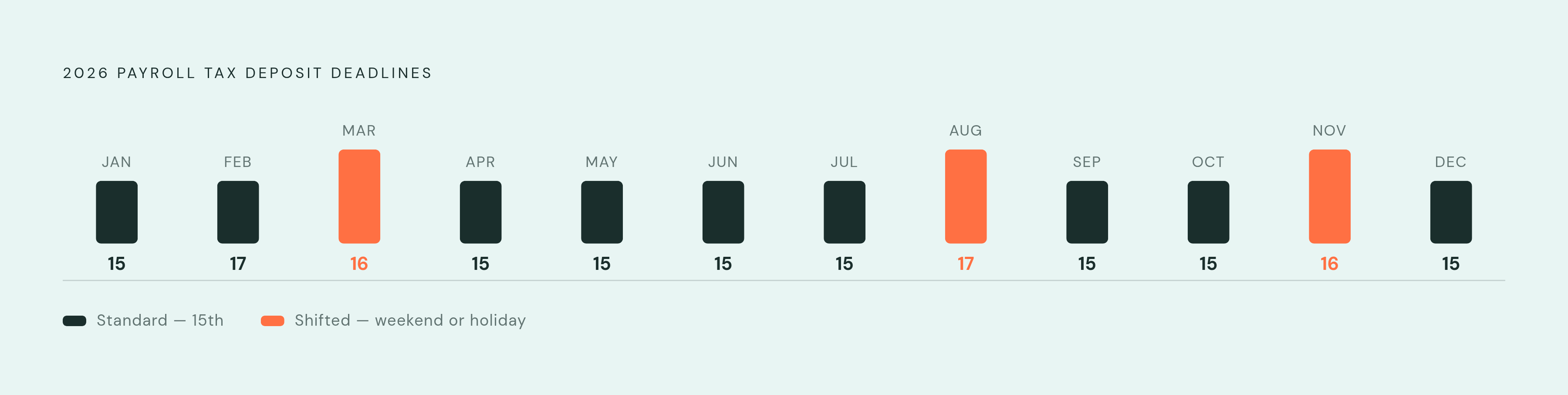
The rule itself is straightforward: whatever payroll tax accumulates over a calendar month gets deposited by the 15th day of the following month. If the 15th lands on a Saturday, Sunday, or federal holiday, the deadline slides to the next business day. For 2026, that produces the following due dates: January 15, February 17, March 16, April 15, May 15, June 15, July 15, August 17, September 15, October 15, November 16, and December 15. March 16, August 17, and November 16 shift later than the 15th, a direct result of the weekend and holiday rule.
Two safety valves soften the monthly rule. First, if total tax liability for an entire quarter comes in under $2,500, no deposits are required at all: the employer can just pay the amount with the quarterly return 2026 Important Payroll Filing Dates and Information. Second, there's a shortfall safe harbor: a deposit still counts as timely even if it falls short, as long as the gap doesn't exceed the greater of $100 or 2% of that period's liability AccountingTitan. Together, these two provisions are why the monthly schedule works so well for small operations. One date a month, tied to the calendar rather than to individual paydays, with a little room for rounding error. It's the most forgiving version of this obligation the IRS offers 2026 Important Payroll Filing Dates and Information AccountingTitan.
Why the semi-weekly schedule is more demanding
Semi-weekly sounds like it describes how often you run payroll. Semi-weekly does not describe how often you run payroll. It describes how often you deposit, and the trigger is payday. If payday falls on a Wednesday, Thursday, or Friday, the deposit is due the following Wednesday. If payday falls on a Saturday, Sunday, Monday, or Tuesday, the deposit is due the following Friday. That's the whole rule, but it has teeth: every single payday sets off its own, independent deposit deadline. Run two payrolls in the same week, maybe one for hourly staff and one for salaried staff, and there are two separate deadlines to track, not one combined figure.
There's a holiday adjustment here too. If any of the three weekdays following the end of a semi-weekly period happens to be a legal holiday, the employer gets one extra business day to make the deposit. The payroll.org 2026 calendar lays out every specific semi-weekly due date for the year, and given how many there are, that's the resource to check rather than trying to memorize them. The real difficulty with this schedule isn't the math. It's the volume of tracking required, especially for a business running multiple or irregular weekly payrolls, where deadlines stack up fast and errors tend to concentrate.
The $100,000 next-day rule for monthly depositors
There's one rule that overrides both schedules entirely. If an employer accumulates $100,000 or more in undeposited payroll tax on any single day within a deposit period, that money has to go in by the next business day, no matter whether the employer is on the monthly or semi-weekly track. It's an emergency-speed deposit obligation, and it doesn't wait for the regular due date to arrive.
Hitting that threshold doesn't just require a fast deposit. It flips the employer's status: a monthly depositor who crosses $100,000 in a single day automatically becomes a semi-weekly depositor for the rest of the current calendar year, and stays semi-weekly for the entire following year too. That's a real consequence, not a one-time inconvenience.
Who runs into this? Mostly fast-growing small businesses, seasonal operations with a concentrated hiring surge, and any employer running an unusually large bonus payroll. For most monthly depositors, this scenario is rare. But it's the one thing capable of rewriting a whole year's compliance calendar overnight, so employers should know it exists rather than check for it daily.
Form 944 and the annual filing option for the very smallest employers
Some employers are small enough that quarterly filing is more paperwork than the situation calls for. Form 944 exists for that group: it's available to employers whose total annual employment tax liability comes to $1,000 or less, which in practice usually means paying $5,000 or less in wages subject to Social Security, Medicare, and federal income tax withholding over the year.
Employers can't just decide to file Form 944 on their own. The IRS has to notify them in writing first, and if a business believes it qualifies but hasn't heard from the IRS, the move is to contact the agency directly and ask for the switch. Form 944 is generally due January 31 of the following year, though that date stretches to February 10 if all taxes were deposited on time.
One claim surfaced during research that deserves a flag rather than a repeat: a single source suggested the IRS plans to eliminate Form 944 starting with the 2026 tax year. That claim does not appear in any IRS primary source found alongside it, so it should be treated as unconfirmed rather than fact until verified directly against IRS.gov. Form 944 filers work off a different lookback period than Form 941 filers, using the second calendar year before the current one rather than the standard July–June window that governs the standard monthly/semi-weekly determination. For Form 944 filers, if total taxes after adjustments and nonrefundable credits are under $2,500 for the year, the employer may pay with a timely filed return rather than making separate deposits, per 1099online.com.
How payroll tax deposits must be made in 2026
Paper is off the table. Every federal tax deposit in 2026 has to be made electronically, a shift the IRS carried out following Executive Order 14247, signed March 25, 2025, and Form 941 refunds now go out by direct deposit only as well. The main channel for this is the Electronic Federal Tax Payment System, EFTPS, a free service run by the U.S. Department of the Treasury. Employers who'd rather not deal with it directly can have a tax professional, a bank, or a payroll service handle the electronic deposit on their behalf.
Timing matters here in a way it didn't with paper checks. A payment has to be scheduled by 8:00 p.m. Eastern Time at least one full calendar day ahead of the actual due date. That's not a same-day system, and treating it like one is how deposits end up late without anyone noticing until the penalty notice arrives.
Getting enrolled takes planning too. The safe move is to start enrollment at least 10 business days ahead of the first deposit due date, not the week before. A deposit made by check instead of EFT triggers the 10% failure-to-deposit penalty rate even if the payment physically arrives on time. Mailing a check isn't a workaround. It's just noncompliance dressed up as an attempt.
The individual-account side of EFTPS is being phased out, with new individual enrollments closed as of October 17, 2025, and a full sunset for individuals expected later in 2026. That change is about personal accounts. Business employer accounts sit in a separate enrollment category, and that phase-out doesn't touch them.
Failure-to-deposit penalty costs in 2026

The penalty structure is tiered, and it applies to each individual deposit that's late, not to the quarter as a whole. A deposit one to five days late costs 2% AccountingTitan. Six to fifteen days late costs 5%.
On top of the penalty, interest accrues separately. As of the quarter beginning July 1, 2026, interest runs at 7% on most outstanding balances, and 9% on large corporate underpayments. The Trust Fund Recovery Penalty underlies all of it: if the IRS decides that a business willfully failed to remit withheld taxes, it can hold individuals personally responsible for 100% of the unpaid trust fund amount, which is the employee-withheld portion only, not the employer's own matching share. That liability isn't confined to the owner, either. It can reach other individuals inside the business found responsible for the failure.
Because penalties apply per deposit rather than per quarter, a single rough quarter with several late deposits doesn't just cost a bit more. It compounds fast, with each missed date adding its own separate charge on top of the last. A deposit made 1 to 5 days late incurs a 2% penalty. A deposit made more than 15 days late incurs a 10% penalty. A 15% penalty applies to amounts still unpaid more than 10 days after the first IRS notice, or on the day the IRS demands immediate payment.
Penalty relief options available to small employers
2026 brought a new relief mechanism, the Automatic Exemption from Penalty, or AEP. It's built for employers with a clean track record of filing and paying on time, and it removes the need to proactively ask the IRS for relief after a missed deposit. It applies per penalty rather than per quarter, though, so if a business racks up several failure-to-deposit penalties in the same quarter, AEP generally only wipes out the first one.
Qualifying for it isn't automatic in the sense of "no requirements." It calls for a clean three-year compliance record, and for quarterly filers specifically, that means 12 consecutive compliant quarters. The relief applies to 2025 returns and to 2026 quarterly filings, with full rollout arriving for returns due on or after January 1, 2027.
For employers who don't yet have that track record, two older paths remain. First-Time Abatement offers similar relief with the same clean three-year history, but it's a request-based process rather than an automatic one. Reasonable Cause abatement covers situations genuinely outside an employer's control: a serious illness, a declared disaster, or a payroll service that simply failed to make the deposit it was supposed to make. That relief gets requested through a written statement or Form 843.
What ties all of this back to the beginning: AEP rewards employers who stay compliant year over year, and it cuts down on the work of chasing penalty relief after the fact. Which makes the schedule determination at the start of the year not just a filing formality, but the decision that everything downstream, deadlines, penalty exposure, and now penalty relief, actually depends on.
Methodology & sources
- 1 2026 Important Payroll Filing Dates and Information
Provided the 2026 monthly deposit due dates, the $50,000 threshold for schedule assignment, the $2,500 quarterly safe harbor, and specific semi-weekly deposit dates.
- Payroll Tax Deposit Schedule Monthly vs Semiweekly 2026 – Uncle Kam
Provided the 2026 Social Security and Medicare tax rates, the wage base of $184,500, and the note that the deposit schedule is fixed for the full calendar year.
- Payroll Tax Deposit Rules | AccountingTitan
Provided details on the $50,000 threshold, new employer default, shortfall safe harbor, and the tiered failure-to-deposit penalty structure including the 15% rate.
- Topic no. 758, Form 941, Employers Quarterly Federal Tax Return and Form 944, Employers Annual Federal Tax Return
Provided the $1,000 annual tax liability threshold that qualifies employers to file Form 944 instead of quarterly Form 941.