Affordable Care Act Reporting Requirements for Small and Midsize Employers
Self-funding your plan can trigger ACA filing requirements even if you stay well below 50 employees.
- Written by
- Payroll Picks Editors
- Published
- October 3, 2026
- Reading time
- 10 min read
- Sources cited
- 8 sources ↓
What this covers
An employer's ACA reporting workload comes down to two questions answered together, not separately: does the business clear 50 full-time equivalent employees, and does it fund its own health plan rather than buy a fully insured policy? Lining those two answers up determines the filing obligation. Most explanations of ACA compliance stop at headcount, as though crossing or staying under 50 employees were the only fact that mattered. That leaves out the variable that trips up a lot of small businesses: how the health plan is funded. A company well under the 50-employee line can still owe the IRS a full set of returns if it self-funds, while a much larger one might assume it has more paperwork ahead than it actually does. Crossing headcount against funding type produces four distinct outcomes: an employer under 50 employees with a fully insured plan owes no filing at all, because the insurer handles it; an employer under 50 that self-insures, including through a level-funded plan, owes Forms 1094-B and 1095-B; an employer at 50 or more that's fully insured owes Forms 1094-C and 1095-C; and an employer at 50 or more that self-insures owes those same C-forms, now carrying the minimum essential coverage reporting inside them. The sections ahead walk through each of these four tracks in order, from the lightest obligation to the heaviest, so an employer can find its own combination.
How the 50-FTE threshold is calculated
The 50-FTE threshold doesn't just count the people working full-time at a company. It adds in part-time and seasonal labor, converted into full-time equivalents, and that conversion can push a business over the line without a single full-time hire. Under IRC §4980H(c)(2), the ACA employer mandate applies if an employer averaged 50 or more full-time equivalent employees over the prior calendar year, and it counts anyone who averages at least 30 hours a week, or 130 hours a month, as full-time. Part-time hours get folded in through a simple formula: total part-time hours worked in a given month, divided by 120, gives that month's part-time FTE contribution, and the IRS requires the result to be rounded down. Add that figure to the full-time count for each of the 12 months, sum all 12 months, and divide by 12. If the average comes out to 50 or more, the business is an Applicable Large Employer for the following year.
A landscaping company illustrates how this plays out. Suppose it runs 40 full-time employees year-round and brings on a wave of seasonal and part-time workers in July. Those extra hands don't need to add up to 10 full-time positions to matter. Their combined hours, divided by 120, can push that single month's FTE count over 50, and that one month feeds into the 12-month average that decides ALE status. Because the test looks backward at the prior year's numbers, a company that crosses the line in 2025 becomes an ALE for 2026, carrying the full reporting burden into a year when its staffing might already look different. That lag means the compliance obligation tends to arrive after the growth that caused it, often catching a business mid-season rather than at the moment it expands.
One more wrinkle deserves a flag rather than a deep dive: the related-company rule under IRC §414 combines businesses under common ownership into a single employer for ALE purposes. A holding company running several smaller entities, each comfortably under 50 employees on its own, can still find itself classified as an ALE once those entities are added together.
What the fully insured small employer owes the IRS
Start with the simplest case: a business under 50 FTEs that buys a fully insured health plan rather than funding claims itself. This employer owes the IRS nothing in the way of ACA information returns. The insurance carrier files the required return and sends employees their coverage statement, and the employer's role in the reporting chain ends there.
That doesn't make the employer invisible to the IRS, though. If an employee buys subsidized coverage on the Marketplace and it later turns out the employer actually met the ALE threshold, that employer's liability becomes visible through the same automated cross-check process described later in this piece, the one built around Forms 1094-C and 1095-C. For a business genuinely under the threshold and fully insured, the administrative load stays light: confirming that the carrier is in fact filing on the company's behalf is worth a quick annual check, but there's no form to prepare, no deadline to track, and no penalty exposure tied to reporting. That changes the moment the employer picks a different way to fund its health plan, and that's the shift the next section covers.
Reporting obligations for small employers with self-insured or level-funded plans
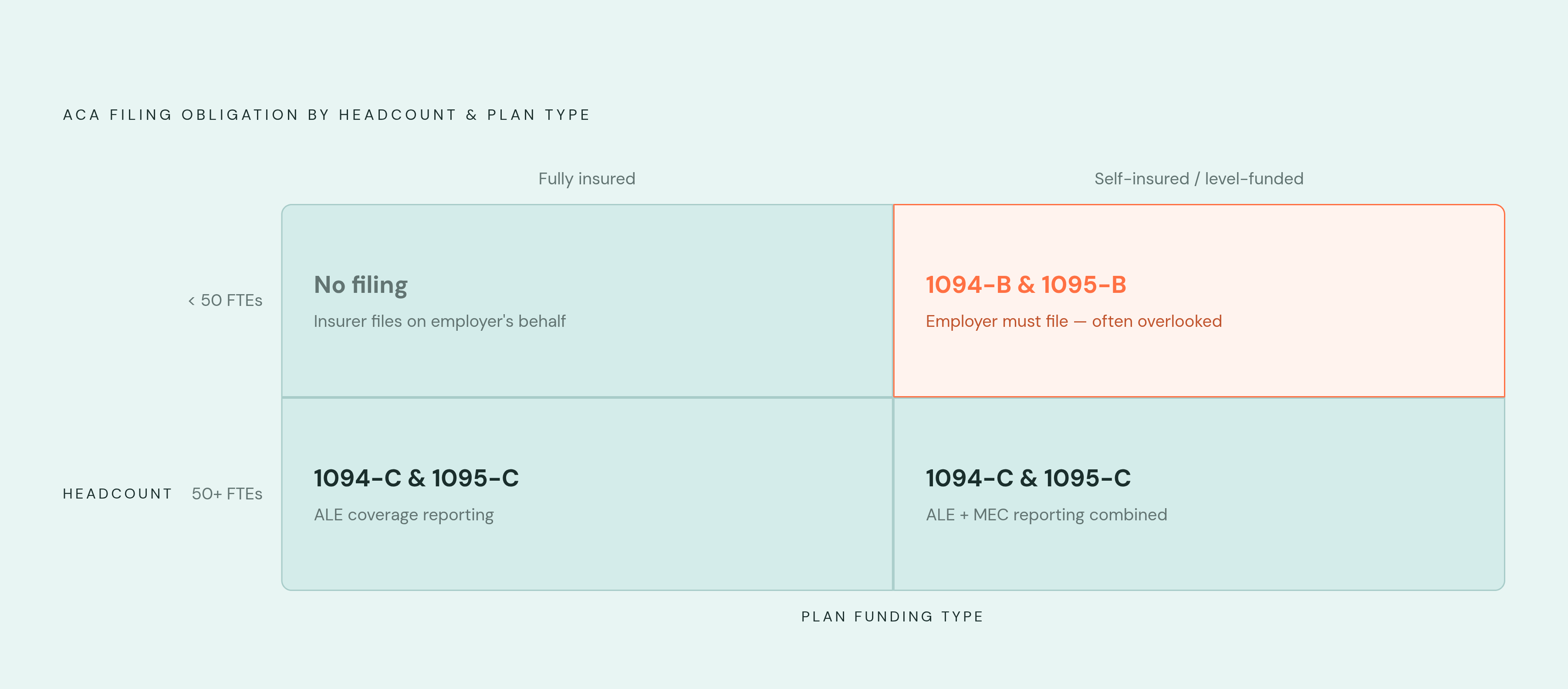
A small employer that self-funds its health plan, including one that has moved to a level-funded arrangement for the cost predictability it offers, gets treated as a self-insurer under ACA rules regardless of its headcount. That status brings a filing obligation many small businesses never see coming: Forms 1094-B and 1095-B, due even though the company sits well under 50 employees.
Level-funded plans sit between fully insured and fully self-insured arrangements, and small businesses have caught on to them because they offer more predictable monthly costs and a shot at a refund at year's end if claims come in low. Carriers typically generate Form 1095-B for employers on level-funded plans, but most carriers do not file those forms electronically with the IRS. Many businesses assume the carrier handles the entire reporting job because it generated the form, but the employer is responsible for submitting Forms 1094-B and 1095-B directly, and this gap catches a lot of businesses off guard. This is a known pattern across the level-funded market and a common occurrence.
Form 1095-B itself asks for the basics on both sides: the covered employee's information, the employer's information, and then, for every person actually covered, including dependents, their name, a government-issued identification number (or date of birth if none is on file), and which months they had coverage. Form 1094-B is the transmittal that rides alongside it, a short form listing the company's name, EIN, address, and a contact person the IRS can reach with questions.
IRC §6055 grounds this same obligation, and it reaches small employers that offer a particular type of health reimbursement arrangement tied to individual coverage. If an employer offers an ICHRA, it becomes the sponsor of a self-insured group health plan, so the same 1095-B and 1094-B filing requirements apply; ICHRA gets fuller treatment later, in the context of affordability. And the stakes for skipping this filing are real even at small scale: eligible small employers that fail to submit their annual return to the IRS face penalties, though the IRS can waive fines for reasonable cause or reduce them when an employer corrects the error promptly.
The 1094-C / 1095-C filing obligation ALE status triggers and what those forms report
Once you clear 50 FTEs, the filing requirement changes for every employer, no matter how the health plan is funded. Both fully insured and self-insured Applicable Large Employers must file Forms 1094-C and 1095-C, and the penalty exposure doesn't stop at missed deadlines. Coding errors on the forms themselves can trigger IRS penalty assessments just as easily as failing to file.
Form 1094-C works as the transmittal: an employer files it once with the IRS to identify itself and summarize coverage data across the whole workforce. Form 1095-C gets filed once per full-time employee, and it carries three pieces of information the IRS cares about most: whether coverage was offered that month, what the employee's share of the lowest-cost plan option cost, and which months coverage was actually available. This is the document the IRS runs against Marketplace subsidy records to check whether an employee who received a premium tax credit should have had affordable employer coverage instead.
Two separate sections of the tax code sit behind this requirement. One governs the ALE's obligation to report offers of coverage, which is what the C-forms are built around. The other governs minimum essential coverage reporting, and if the ALE is self-insured, that reporting doesn't need separate B-forms. It gets folded directly into the same 1094-C and 1095-C filings. The obligation extends to ALEs offering an ICHRA as well: any employer at 50 or more FTEs that offers a group health plan, an ICHRA, or both has to meet these filing requirements.
Accuracy matters more now than it used to, because the good-faith compliance safe harbor that once protected employers from penalties over minor coding mistakes on these forms is no longer available. Whoever prepares these filings needs to know the relevant codes well and keep documentation current throughout the year, because an error caught after filing brings real financial consequences, not just a warning.
The 2026 filing deadlines and the electronic-filing rule that now applies to nearly all employers
For coverage provided in 2025, every key ACA filing deadline falls in early 2026, and a tightened electronic-filing rule means paper filing is no longer a realistic option for almost any employer with a payroll. The IRS now requires electronic filing once an employer's total information returns, counting W-2s, 1099s, and ACA forms together, reach 10 or more in a year. The threshold counts all return types in aggregate, not ACA forms alone, so if a business issues W-2s, it ends up required to file electronically no matter how small its workforce is.
Three dates matter for the 2025 reporting year. Employers must furnish Form 1095 to employees by March 2, 2026; that date reflects a 30-day extension from the original January 31 deadline, and it's now permanent, written into IRS regulations rather than granted year to year. Electronic filing with the IRS for Forms 1094 and 1095 is due March 31, 2026. Paper filing, where it's still allowed at all, is due March 2, 2026, though that option only remains open to the smallest filers who fall under the 10-return aggregate threshold. If an employer needs more time on the IRS filing side, it can submit Form 8809 before the original deadline to get an automatic 30-day extension, but that extension covers IRS filing only and doesn't move the employee furnishing deadline.
The most useful change for the 2026 cycle comes from the Paperwork Burden Reduction Act, signed into law in December 2024. It lets employers satisfy the employee-furnishing requirement by posting a clear, accessible notice on the company website instead of mailing a paper form to every employee. The notice has to go up by March 2, 2026, include an email address, mailing address, and phone number employees can use to request a copy of their form, and stay in the same location on the website through October 15, 2026. If an employee does request a copy, the employer has to provide it within a set number of days of that request, or within the same window following March 2, whichever comes later.
Employer groups have raised a real concern about this approach. If employees don't know they can request Form 1095-C, they risk missing documentation they need for accurate tax filing, so the risk of an error shifts from the employer's filing process onto the worker's return. If an employer chooses the website-notice route, it should make sure that notice is genuinely easy to find, not buried several clicks deep on a benefits page nobody visits after open enrollment.
Affordability rules and safe harbors for 2026
Filing the right forms on time doesn't fully protect an employer from penalties. Coverage also has to be affordable, and getting that calculation wrong exposes the business to a §4980H(b) penalty even when every form was filed correctly and on schedule. For 2026, coverage counts as affordable if the employee's share of the lowest-cost, employee-only plan option doesn't exceed 9.96% of household income, the highest that threshold has ever been set, which gives employers more room than in prior years before a plan tips into unaffordable territory. No employer actually knows its employees' household income, so the IRS built three safe harbors that let a business check affordability using numbers it can actually see.
The Federal Poverty Line safe harbor is the easiest of the three to administer because it requires no calculation specific to any individual employee. An employer satisfies it by offering at least one plan where employee-only coverage costs no more than a published monthly dollar cap, a figure derived by taking the federal poverty level, multiplying it by the affordability percentage, and dividing by twelve. The Rate of Pay safe harbor works for hourly employees and takes their hourly wage, multiplies it by a standard monthly hours figure, then applies the same affordability percentage, producing a contribution ceiling tailored to each employee's pay rate. The W-2 safe harbor checks the employee's actual contribution against the affordability percentage applied to their Box 1 W-2 wages, but W-2 wages aren't final until the year ends, so an employer can only use this safe harbor as a backward-looking check, not something it can confirm in advance.
If an employer satisfies any one of these three safe harbors, it's protected from a §4980H(b) penalty, even if the employee's real household income would have produced a different affordability result under the strict statutory test. The same affordability percentage carries over into ICHRA arrangements: for 2026, an ICHRA counts as affordable when the employee's required contribution toward a self-only silver-level Marketplace plan doesn't exceed that same 9.96% share of household income, giving employers offering ICHRAs the same benchmark that applies to traditional group coverage.
Methodology & sources
- What Are the 2026 ACA Reporting Requirements?
Provided the 2026 affordability threshold percentage and details on ICHRA filing requirements for ALEs.
- Important Reporting Obligations Under the Affordable Care Act (ACA) - SEK CPAs
Supported details on the employee-furnishing deadline, the later-of rule for providing requested forms, and ICHRA affordability benchmarks.
- ACA Reporting Requirements For Small Businesses
Provided context on small employer ACA reporting obligations, including the distinction between B-forms and C-forms for self-insured small employers.
- Employer shared responsibility provisions
Grounded the explanation of IRC §4980H and the ALE definition, including the 30-hour-per-week and 130-hour-per-month full-time employee thresholds.
- How Do I Know If I Have 50 Full-Time Employees for ACA? Complete 2026 Guide
Explained the FTE calculation method, including dividing part-time hours by 120 and rounding down, used in the threshold section.
- ACA Reporting Requirements in 2026
Provided detail on the three ACA affordability safe harbors, including the Rate of Pay and W-2 methods.
- Understanding Affordable Care Act (ACA) Filing Requirements for Small Groups - MyHRConcierge
Informed the discussion of level-funded plans and the common misconception that carriers handle all filing obligations for small employers.
- Fast-Approaching Deadlines for ACA Reporting and Similar State Reporting
Confirmed the 2026 ACA filing deadlines and details about the Paperwork Burden Reduction Act's website-notice alternative for employee furnishing.