Employee vs Independent Contractor Misclassification Risks in Payroll
Misclassification debts compound quietly until regulators demand repayment with penalties.

- Written by
- Payroll Picks Editors
- Published
- September 30, 2026
- Reading time
- 11 min read
- Sources cited
- 8 sources ↓
What this covers
Misclassifying a worker as an independent contractor does not change what payroll obligations are owed. It only delays when someone comes to collect them. A signed contractor agreement, a 1099 form, and a fully remote arrangement carry no legal weight against a regulator or a court, which will instead look past the paperwork to the actual working relationship: who controls the schedule, how integrated the worker is into the business, and how dependent that worker is on the company for income. When that relationship functions like employment, every payroll tax that should have been withheld, every overtime hour that should have been paid, and every benefit contribution that should have accrued becomes a debt from the first day of the arrangement, not from the day someone notices the error.
The incentive to misclassify is straightforward. Contractor status lets an employer skip payroll taxes, overtime, health and retirement benefits, and workers' compensation premiums. But each dollar saved this way is a contingent liability on the books that compounds the longer the arrangement runs. Regulators do not treat this as bookkeeping sloppiness. Misclassification pushes the entire burden of Social Security and Medicare contributions onto the worker, while simultaneously shrinking the total revenue flowing into the social insurance system that funds those programs. That dual harm, to the individual worker and to the public system, is why agencies pursue these cases as a matter of structural policy rather than isolated technical violations.
The scale of the practice is what makes it a payroll-wide concern rather than a scattering of edge cases. The National Employment Law Project, working from state-level reports, estimated that somewhere between 10% and 30% of employers misclassify at least some of their workforce. That range covers a meaningful share of payrolls, and it means most employers face the question of how much classification risk exists in their organization. It's how much of it does, and how long it has been accruing.
Why there is no single classification test
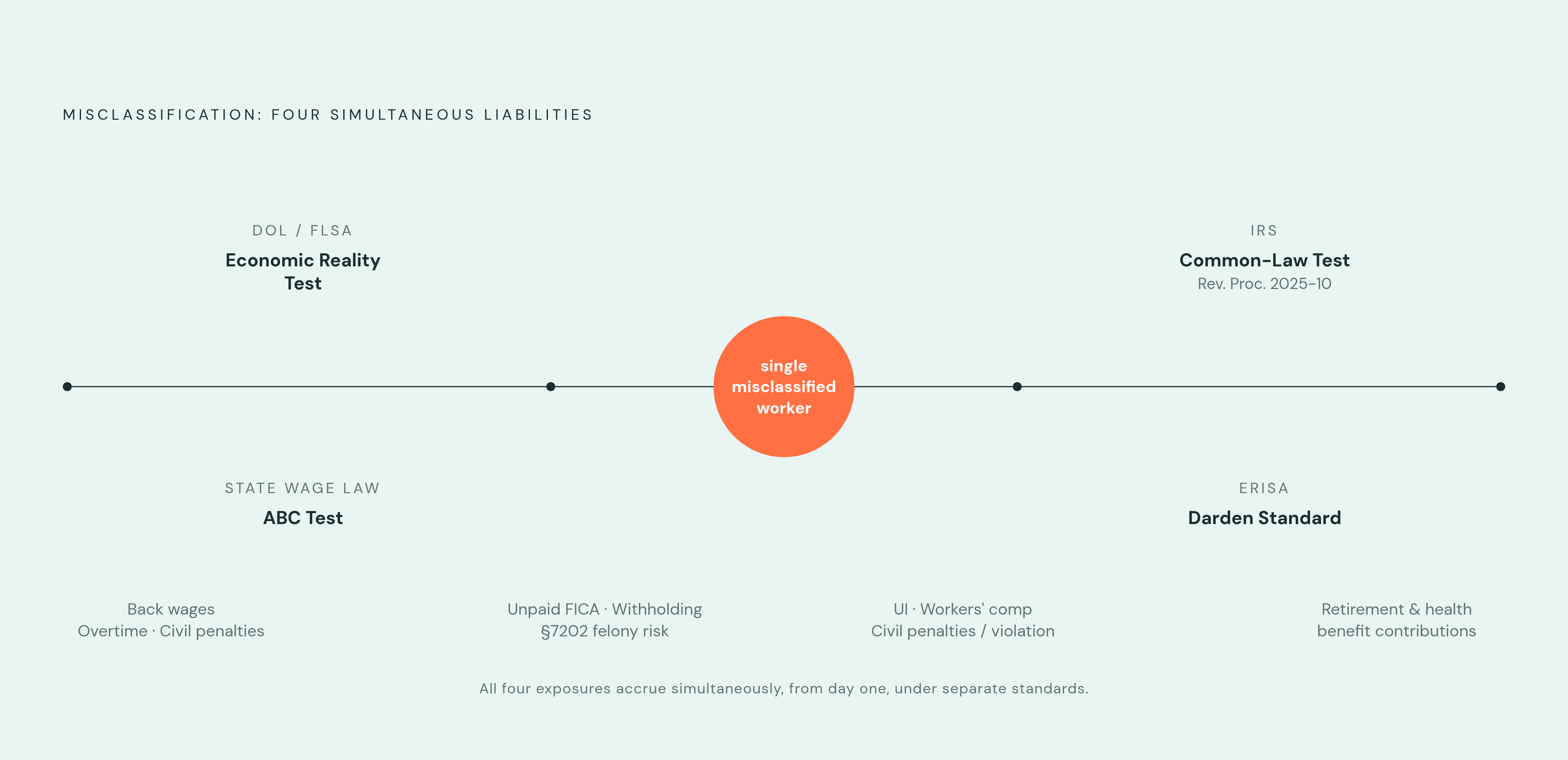
Part of what makes classification so easy to get wrong is that no single test decides it. The same working relationship gets evaluated under at least four separate legal regimes, and each one applies its own standard. Passing one test says nothing about whether the arrangement survives scrutiny under the others.
The Department of Labor applies an economic reality test under the FLSA to determine who is owed minimum wage, overtime, and recordkeeping protections. The IRS applies a common-law test built around behavioral control, financial control, and the nature of the relationship, and that standard governs employment taxes, withholding, and whether a worker gets a W-2 or a 1099. State wage law adds a third layer, often built around an ABC test rather than the federal economic reality standard, and it governs unemployment insurance and workers' compensation eligibility. Then ERISA and the language of individual benefit plans apply a common-law standard drawn from the Darden decision, sometimes narrowed further by plan-specific eligibility language, to decide who qualifies for retirement and health coverage.
None of these regimes defers to the others. An employer that satisfies the IRS test and ignores its state's ABC test has resolved one exposure and preserved another, and the liabilities run in parallel rather than in sequence. The liabilities don't queue up one after another. They run in parallel, so a single misclassified worker can generate an IRS tax exposure, a state wage claim, and an ERISA benefits dispute simultaneously, each assessed under a different legal standard.
The IRS test itself got sharper in 2025. Revenue Procedure 2025-10 clarified the right-to-control standard, making explicit that a contract calling someone a contractor gets overridden by how the work actually functions. If the employer dictates the means and methods of the work, not merely the end result, the worker is an employee for tax purposes regardless of what the paperwork says. State law can be even less forgiving. California's ABC test presumes every worker is an employee, and the burden falls on the employer to affirmatively prove all three prongs of the test to overcome that presumption, a structurally harder position than anything in federal law.
International hiring adds another dimension. Multiplier's Global Talent Squeeze Report, produced in partnership with TriNet and based on a survey of 500 senior business leaders, found that the large majority of U.S. small businesses now use contingent workers based outside the country, a higher share than larger enterprises rely on. Classification rules differ drastically from one country to the next, and in some cases from one province to another within the same country, so a small business hiring internationally is often juggling more classification regimes than a much larger domestic employer.
The federal standard in 2026 and the risk of its split posture
The DOL's enforcement posture and the legal standard applicable to private lawsuits are currently different things, and that gap, produced by a specific sequence of regulatory events rather than a simple retreat from regulation, is where misclassification litigation risk is concentrated.
On January 10, 2024, a final rule was published, effective March 11, 2024, replacing the 2021 standard with a six-factor totality-of-the-circumstances economic reality test in which no single factor was presumptively controlling. That rule raised the bar for treating workers as contractors and drew immediate pushback from industries that rely heavily on independent labor.
The earlier economic reality analysis in Fact Sheet #13 (2008) and Opinion Letter FLSA2019-6 also uses a multi-factor totality-of-the-circumstances test without any single factor being presumptively controlling.
None of that sequence has erased the 2024 rule from the books. It remains the operative standard for private FLSA litigation even though DOL investigators have been told not to apply it. A plaintiff's attorney building a collective action over independent contractor status can still invoke the stricter six-factor test, regardless of what enforcement guidance the DOL currently follows. Reduced federal enforcement posture and continuing private lawsuit risk under the stricter 2024 standard are not the same thing, and employers who relax classification practices on the assumption that federal heat has cooled remain exposed to class and collective actions.
Practitioners themselves are divided on whether the DOL's retreat signals a genuinely lighter long-term enforcement environment or a temporary procedural pause. That disagreement is itself a risk factor. Classification decisions made today will be judged, whenever a dispute eventually surfaces, under whatever standard happens to be in force at that later date, not under today's enforcement posture.
The IRS's 2025 update to the Section 530 safe harbor
While the DOL's rulemaking has been in flux, the IRS made its own consequential move in 2025. Revenue Procedure 2025-10 delivered the first major update to Section 530 guidance in roughly 40 years, and it tightened the conditions under which an employer can rely on that safe harbor to avoid employment tax liability for a misclassified worker.
Section 530 of the Revenue Act of 1978 gives employers a defensive tool: if there was a reasonable basis for treating a group of workers as contractors, the employer can avoid retroactive employment tax liability even if those workers turn out to be employees under the common-law test. It functions purely as a shield against liability that has already accrued. It offers no protection to an employer that cannot document why the contractor treatment was reasonable in the first place, and it does nothing to fix a misclassification going forward.
Revenue Procedure 2025-10 sharpens what counts as inconsistent treatment that would forfeit the safe harbor. Withholding income or FICA taxes for a worker, issuing that worker a W-2, or filing employment tax returns that treat the worker as an employee all signal employee treatment and can undercut Section 530 eligibility. None of this represents a wholesale change in what the safe harbor requires. The underlying conditions for reasonable reliance haven't shifted dramatically. What changed is the clarity of the standard, and that clarity removes the room many employers previously had to assume the safe harbor applied without having built the documentation to prove it. An employer that has been informally consistent about contractor treatment, without a paper trail showing why that treatment was reasonable at the time it began, is in a measurably weaker position than it was before the update.
The layered financial consequences of a misclassification finding, from IRS penalties to state liability
A misclassification finding rarely produces one bill. It produces a stack of them, arriving from different agencies, calculated under different formulas, and scaling with both the number of affected workers and the length of time the misclassification persisted.
Start with the IRS side, where unintentional misclassification is treated under Section 3509. Penalties for unfiled W-2s begin at a modest per-form amount, but that's just the entry point. The employer also owes a percentage of the income tax that should have been withheld, plus a percentage of unpaid employee FICA taxes on top of the full employer share of FICA that was never paid, with interest accruing on the entire unpaid balance the whole time.
Willful misclassification removes the reduced Section 3509 rates entirely, and the consequences escalate sharply from there. Willful failure to collect and pay over employment taxes is a felony under IRC Section 7202, punishable by substantial fines and up to five years in prison. Business owners and officers can be held personally liable in these cases, and the corporate structure offers no shelter once willfulness is established.
That's the tax side alone. The DOL adds its own liability for back wages owed under FLSA minimum wage and overtime rules, plus civil money penalties for violations found to be willful or repeated. States layer on further exposure: California, for instance, can impose civil penalties reaching tens of thousands of dollars per violation, independent of federal penalties and separate from any unpaid state unemployment insurance or workers' compensation premiums that come due.
These liabilities rarely stay contained within one agency. One finding typically triggers audits across multiple agencies: IRS, DOL, and state labor agencies do not operate in isolation, and a finding by one often prompts referrals to others. The IRS can also reach back as far as six years to assess back taxes covering FICA, FUTA, income tax withholding, interest, and penalties, so the financial exposure for a single misclassified worker spans years, not months.
An analysis from employeevscontractor.com put the combined cost of misclassifying a single worker, factoring in IRS back taxes, DOL fines, state penalties, and legal fees, well into six figures. That figure describes one worker, and multiplied across a workforce, the exposure for a mid-sized employer running a systemic misclassification pattern becomes an existential financial event.
Recent settlements show how industries get caught
Enforcement activity through 2025 and 2026 makes one pattern unmistakable: the companies getting caught are concentrated in traditional industries, not gig-economy platforms, and the settlements that result routinely run into the millions of dollars after years of litigation.
The scale of federal recovery gives some sense of the enforcement environment behind these cases. In fiscal year 2025, the DOL's Wage and Hour Division recovered hundreds of millions of dollars in back wages for a large number of workers, the highest recovery total the division had posted since 2019. Once penalties were factored in, the total climbed considerably higher still, marking a notable jump over the prior year.
Individual cases illustrate how long these disputes can drag on before resolution. On July 30, 2026, U.S. District Judge Jacqueline Scott Corley granted final approval of a class action settlement against Grubhub, following preliminary approval in March of that year, closing out nearly a decade of litigation over the alleged misclassification of California delivery drivers as independent contractors. Construction carries its own exposure: electrical contractor Power Design agreed to a multi-million-dollar payment in 2024 after a city lawsuit uncovered widespread misclassification, marking the largest workers' rights recovery in the history of Washington, D.C..
Logistics and transportation show the same pattern of prolonged litigation. National Freight and NFI Interactive Logistics settled a class action for millions of dollars, in a case originally filed in 2015 under the New Jersey Wage Payment Law and only resolved after a decade that included a class certification motion, summary judgment motions, and five separate mediations. A multi-million-dollar settlement in the automotive parts distribution sector covering a large group of delivery drivers followed a similar arc, Lexology reported. Minnesota's attorney general, Keith Ellison, separately reached a settlement with delivery company Shipt over allegations of misclassifying its delivery workers.
Across these cases, the majority of misclassification enforcement continues to target transportation, healthcare, consumer sales, financial services, utilities, and real estate, rather than the app-based platforms that tend to dominate public conversation about contractor status. The NFI and Grubhub cases each stretched for the better part of a decade, and liability kept accruing the entire time they were pending. That duration is itself the lesson: intervening early, before a classification dispute calcifies into a decade-long class action, carries a compounding financial benefit that only grows the longer an employer waits.
The cost misclassification imposes on workers
None of this enforcement intensity exists in a vacuum. It responds to measurable financial harm borne by the workers on the losing end of these classification decisions, and that harm is large enough, and well-documented enough, to guarantee continued regulatory and legislative pressure no matter what happens to federal enforcement posture.
The Economic Policy Institute's analysis found that a typical construction worker misclassified as an independent contractor loses as much as $19,526 a year in income and job benefits compared with what that same worker would earn as an employee. Truck drivers face a comparably steep loss, with EPI's estimates running even higher for drivers specifically in New Jersey. Home health aides, janitors, and landscapers rank among the occupations hit hardest, and these tend to be lower-paying jobs to begin with, so the proportional damage to a misclassified worker's household finances is often the most severe precisely where workers can least absorb it.
What gets stripped away goes well beyond a paycheck. Misclassified workers lose eligibility for minimum wage and overtime protections, unemployment insurance, and workers' compensation coverage. They lose access to paid sick or family leave where state law would otherwise require it, employer-sponsored health insurance and retirement contributions, NLRA protections that would let them organize, and, in most states, federal anti-discrimination protections that only attach to employees.
Employers sometimes defend contractor arrangements on the grounds that workers themselves prefer the flexibility. EPI's analysis pushes back on that framing directly, noting that the flexibility many employers point to is frequently illusory, given how much control those same employers retain over schedules and work assignments. A worker told when to show up, which routes to run, and how to perform the job has little of the independence the contractor label implies.
State legislatures have not waited for federal rulemaking to catch up. Through 2025 and 2026, lawmakers in numerous states introduced or passed legislation aimed at strengthening employer accountability, expanding worker remedies, and building out enforcement capacity around misclassification. That legislative activity is running independently of the federal rollback in DOL enforcement, and it means the regulatory pressure on employers is intensifying at the state level even as federal posture remains unsettled. The financial harm to workers is what sustains that pressure, and it is not going away regardless of which standard the DOL ultimately adopts.
Methodology & sources
- Final Rule: Employee or Independent Contractor Classification Under the Fair Labor Standards Act, RIN 1235-AA43 | U.S. Department of Labor
Provided details on the January 2024 final rule establishing the six-factor economic realities test effective March 11, 2024.
- Misclassifying workers as independent contractors is costly for workers and states
Provided the figures on the share of employers who misclassify workers and the estimated annual income loss for misclassified construction workers.
- Misclassification of Employees as Independent Contractors Under the Fair Labor Standards Act | U.S. Department of Labor
Provided background on the DOL's economic reality test under the FLSA and the Fact Sheet #13 multi-factor analysis referenced in the article.
- Worker Classification 101: employee or independent contractor | Internal Revenue Service
Provided background on the IRS common-law test covering behavioral control, financial control, and nature of the relationship used to determine worker classification.
- IRS Updates Guidance on Section 530 and Worker Status Issues | Littler
Provided details on Revenue Procedure 2025-10's update to Section 530 safe harbor conditions, including what conduct constitutes inconsistent treatment.
- Safeguarding Independent Contractor Classifications: IRS Issues First Major Update to Section 530 Relief in 40 Years (Revenue Procedure 2025-10)
Confirmed that Revenue Procedure 2025-10 was the first major update to Section 530 guidance in roughly 40 years.
- US Department of Labor issues guidance on independent contractor misclassification enforcement | U.S. Department of Labor
Provided the DOL Wage and Hour Division's fiscal year 2025 back-wage recovery figures cited in the enforcement settlements section.
- New Independent Contractor Judgment, Settlement, and Lawsuits: IC Legal News Update February 2026 | Independent Contractor Misclassification & Compliance
Provided details on recent misclassification settlements including the Grubhub class action and NFI logistics cases.